



The loss of topsoil on American farms is threatening the country’s food supply and demands a new commitment to conservation, Trump administration officials said Tuesday. They also say the White…
USDA Launches $700M Regenerative Agriculture Program
Agri-Pulse’s Steve Davies reported that “the Trump administration is launching a $700 million initiative, potentially supplemented with corporate funding, to help farmers adopt regenerative agriculture practices.”
“In an announcement at USDA (yesterday) morning, Agriculture Secretary Brooke Rollins said the funding for the pilot project would be delivered ‘through existing programs our farmers already know and already trust,’ which Natural Resources Conservation Service Chief Aubrey Bettencourt specified would be the Environmental Quality Incentives Program and the Conservation Stewardship Program,” Davies reported. “‘It’ll be the same application that our farmers know already,’ Bettencourt said. ‘The difference is, they’ll be able to apply for multiple practices on a single application.'”
“She added that ‘what’s important about that is, it ties back to that whole-farm plan, the idea being that we’re going to look at all of the resource concerns on the property at one time, instead of drive-by conservation, where we’re only looking at maybe soil health here, and maybe in a few years, we’re going to look at water management,'” Davies reported.
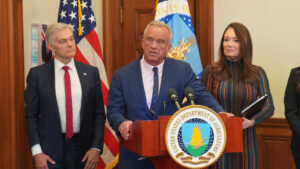
“Regenerative agriculture has no widely agreed-upon definition, but Rollins called it ‘a conservation management approach that emphasizes natural resources through improved soil health, water management and natural vitality for the productivity and prosperity of American agriculture and all of our communities,” Davies reported.
“The program appears similar to the $1.4 billion Partnership for Climate-Smart Commodities program begun during the Biden administration,” Davies reported. “That program, which was canceled and then rebranded as Advancing Markets for Producers, uses both government and corporate matching funds to help farmers implement a host of conservation practices.”
Progressive Farmer’s Chris Clayton reported that “it should be highlighted that the Trump administration has pressed to reduce NRCS’s staffing and Conservation Technical Assistance funding this past year. Through elimination of probationary staff and early retirement buyouts, USDA cut nearly 2,400 NRCS staff this year, roughly a 20% decline in staff. The department’s proposed budget for FY 2026 also called for cutting another 1,200 positions and dramatically cutting CTA funding. Congressional appropriators, however, rejected those proposed cuts to the department’s budget.”
Program Will Utilize EQIP and CSP Funds
Clayton reported that “the pilot program will use $400 million from the Environmental Quality Incentives Program (EQIP) and $300 million from the Conservation Stewardship Program (CSP) and will also leverage private funding to promote conservation practices such as cover crops while helping farmers reduce the use of chemicals such as pesticides.”
“(Health and Human Services Secretary Robert F. Kennedy Jr.) pointed out the push for regenerative agriculture was a goal of the MAHA report released in September,” Clayton reported. “One MAHA focus is to find a way to make farmers less dependent on chemicals and fertilizer inputs, Kennedy said, and they need a way to transition to a model that emphasizes soil health.”
.@SecRollins announces the launch of a new pilot program to invest $700M to support regenerative agriculture 🌱🌾 pic.twitter.com/Lpur0MYwof
— Rapid Response 47 (@RapidResponse47) December 10, 2025
“‘And with soil health comes nutrient density — and without coercion, voluntary action gives them good incentives to do well by doing good for themselves, for their children and for the country,’ Kennedy said,” according to Clayton’s reporting. “Saying there are too many chemicals on the land, Kennedy credited farmers who have been using regenerative practices to reduce their inputs. ‘They are inspiring to the farm community, to all of us who care about good health, about sustainability on the farm, about soil, about water retention, about soil retention,’ he said.
Early Reactions to Program Mixed
Bloomberg’s Michael Hirtzer and Kristina Peterson reported that “Farm Action, a nonpartisan group advocating for fair and sustainable food systems, said it welcomed the program. The group is against large multinational companies from receiving benefits at the expense of smaller farms.”
“‘Regenerative agriculture is not only better for the land and public health, but it also creates a path to rebuilding farmer profitability and reducing dependency on costly chemicals and other inputs controlled by a few giant companies,’ said Angela Huffman, Farm Action’s president,” according to Hirtzer and Peterson’s reporting. “Stephanie Feldstein, population and sustainability director at the Center for Biological Diversity, said more details are needed.”
“‘Farmers trying to do the right thing for our environment need all the support they can get, but without clear standards this ill-defined pilot program isn’t enough,’ she said in a statement,” according to Hirtzer and Peterson’s reporting.
