



The US meatpacking industry faces a fresh wave of scrutiny, this time from Senate Democrats seeking to allow companies to process only one type of meat and set stricter limits…
USDA to Release Sterile Screwworm Flies in Texas
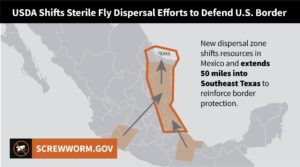
Progressive Farmer’s Jennifer Carrico reported that “USDA’s Animal and Plant Health Inspection Service (APHIS) has shifted sterile New World screwworm (NWS) fly release to include into Texas to help efforts to stop the northern spread of the pest.”
“In an APHIS news release late Friday, APHIS stated the new dispersal area, or polygon, will include operations about 50 miles into Texas, along the U.S. border with the state of Tamaulipas, Mexico, where 100 million sterile flies will be released per week,” Carrico reported. “Strong surveillance will continue along the border and in Texas as well.”
“‘At Secretary (Brooke) Rollins’ direction, our highest priority is protecting the United States from screwworm,’ Dudley Hoskins, under secretary of Marketing and Regulatory Programs for USDA said in the Friday statement,” according to Carrico’s reporting. “‘The northernmost active case of NWS in Mexico is still about 200 miles away from the border, but we’ve seen cases continue to spread in Tamaulipas and further south in Mexico, so we are proactively shifting our polygon as we make every effort to prevent NWS from reaching our border.'”
“The sterile insect technique has been used since it was first used in 1936 to fight NWS. The same technique is used in present day for eradication,” Carrico reported. “The flies are sterilized using ionizing radiation prior to release. Since the flies only mate once, no offspring are produced, thus drastically reducing the wild NWS population. This, paired with surveillance, movement restrictions, education and outreach, should help control and eradicate NWS.”
Agri-Pulse’s Noah Wicks reported that “three total screwworm cases had been detected in the Mexican state of Nuevo Leon as of Jan. 27, though none were classified as ‘active,’ according to a USDA tracker. Meanwhile, Tamaulipas had eight active cases out of 20 overall cases, while San Luis Potosí had five active cases out of 11 total cases.”
Texas Governor Issues Disaster Declaration
Houston Public Media’s Marian Navarro reported that “Gov. Greg Abbott has issued a statewide disaster declaration to prevent the potential spread of the New World screwworm into Texas. The harmful parasite presents a serious threat to the livestock industry and wildlife.”
“Abbott’s declaration comes as reported cases of NWS continue to move closer and closer to the Texas-Mexico border,” Navarro reported. “The preemptive declaration directs the Texas Parks and Wildlife Department and the Texas Animal Health Commission to establish a joint Texas New World Screwworm Response Team. ‘The Texas NWS response team can fully utilize all state government prevention and response resources to prevent the re-emergence of this destructive parasite,’ said Abbott in a release. ‘Texas is prepared to fully eradicate this pest if need be.'”
“Texas Agriculture Commissioner Sid Miller had previously urged for heightened surveillance following the spread of cases in Mexico,” Navarro reported. “‘The Governor’s disaster declaration gives his task force greater authority, resources, and speed needed to confront the growing threat posed by the New World screwworm,’ Miller said.”
USDA Previously Launched NWS Grand Challenge
Feedstuffs reported in mid-January that “Agriculture Secretary Brooke Rollins announced the launch of the New World screwworm (NWS) Grand Challenge as a key step in the U.S. Department of Agriculture’s comprehensive strategy to combat NWS and prevent its northward spread.”
“As part of the Grand Challenge funding opportunity announced Wednesday, USDA’s Animal & Plant Health Inspection Service will make up to $100 million available to support innovative projects that enhance sterile NWS fly production, strengthen preparedness and response strategies and safeguard U.S. agriculture, animal health and trade, the agency said,” according to Feedstuffs’ reporting. “For USDA’s NWS Grand Challenge, APHIS is inviting proposals until Feb. 23, 2026, for projects that support one or more of the following objectives: Enhance sterile NWS fly production, Develop novel NWS traps and lures, Develop and increase understanding of NWS therapeutics/treatments (i.e., products that could treat, prevent or control NWS) for animals (and) Develop other tools to bolster preparedness or response to NWS.”
“‘These are the kinds of innovations that will help us stay ahead of this pest and protect our food supply and our economy, protecting the way of life of our ranchers and go towards rebuilding our cattle herd to lower consumer prices on grocery store shelves,’ Rollins said in the news release,” according to Feedstuffs’ reporting. “‘We know we have tried-and-true tools and methods to defeat this pest, but we must constantly look for new and better methods and innovate our way to success. Together, through science, innovation and collaboration, we can ensure we’re utilizing the latest tools and technology to combat NWS in Mexico and Central America and keep it out of the United States.'”
