



Massive wildfires have burned vast swaths of grazing lands in Nebraska, endangering cattle producers' plans for production increases that could help ease record-high U.S. beef prices. The loss of grasslands…
Human Case of New World Screwworm Confirmed in US
Reuters’ Cassandra Garrison, Tom Polansek and Leah Douglas reported that “the U.S. Department of Health and Human Services on Sunday reported the first human case in the United States of travel-associated New World screwworm, a flesh-eating parasite, from an outbreak-affected country.”
“The case, investigated by the Maryland Department of Health and the U.S. Centers for Disease Control and Prevention, was confirmed by the CDC as New World screwworm on August 4, and involved a patient who returned from travel to El Salvador, HHS spokesman Andrew G. Nixon said in an email to Reuters,” Garrison, Polansek and Douglas reported.
“Earlier, Reuters reported that beef industry sources said last week that the CDC had confirmed a case of New World screwworm in a person in Maryland who had traveled to the United States from Guatemala. Nixon did not address the discrepancy on the source of the human case,” Garrison, Polansek and Douglas reported. “‘The risk to public health in the United States from this introduction is very low,’ he said. The U.S. government has not confirmed any cases in animals this year.”
“The differing accounts from the U.S. government and industry sources on the human case are likely to further rattle an industry of cattle ranchers, beef producers and livestock traders already on high alert for potential U.S. infestations as screwworm has moved northward from Central America and southern Mexico,” Garrison, Polansek and Douglas reported. “…A human case and the lack of transparency around it could present a political challenge for (Ag Secretary Brooke) Rollins. The USDA has set traps and sent mounted officers along the border, but it has faced criticism from some cattle producers and market analysts for not acting faster to pursue increased fly production.”
How is the USDA Addressing New World Screwworm?
NBC News’ Patrick Smith reported that “U.S. Secretary of Agriculture Brooke L. Rollins traveled to Texas to announce a five-part plan to combat the screwworm on Aug. 15. This includes plans to breed billions of sterile flies and dump them from the air over southern Texas and Mexico in the hope of stopping the parasite’s spread.”
“The sterilized male flies mate with females, but the eggs don’t hatch,” Smith reported. “Eventually, the population reduces and dies out. This technique worked in the 1960s when the U.S. suffered its last screwworm outbreak.”
“And the federal government may face calls to accelerate its work on this: When first announced in June, the sterilization plan wasn’t due to be operational for ‘two to three years,'” Smith reported. “Texas Gov. Greg Abbot, commenting on the federal government scheme, said the state agriculture industry, with its 2 million jobs, was worth $867 billion. ‘All of this is at risk because of the New World screwworm.'”
What is the New World Screwworm?
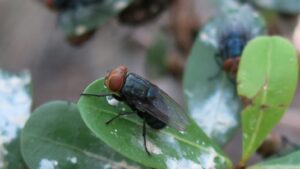
Bloomberg’s Jason Gale reported that “New World screwworms (Cochliomyia hominivorax) are parasitic flies that lay eggs in the wounds of warm-blooded animals. The larvae burrow into living tissue — like a screw twisting into wood — causing severe damage and, if untreated, death. Most infestations strike cattle, wildlife and pets, but humans can occasionally be affected. Treatment involves removing the larvae and disinfecting the wound. Caught early, it’s usually successful, though extracting hundreds of maggots can be arduous.”
“For the general public, the risk of infection in the US is very low,” Gale reported. “…The bigger concern is for cattle and other animals, where screwworm can spread rapidly and kill even fully grown livestock in as little as 10 days if untreated, according to the UN Food and Agriculture Organization. After a case was detected 370 miles south of the US-Mexico border in July, the US closed southern ports of entry to livestock. Earlier detections less than 700 miles from the border had already triggered restrictions on Mexican cattle, bison and horses in May. Even a single confirmed case in a person is enough to rattle the industry, given the parasite’s destructive history.”
