



Senate Agriculture Chair John Boozman said Monday he plans to soon take up a five-year farm bill, regardless of delays a similar bill may face in the House. Asked at…
ARC, PLC Signup to be Significantly Delayed
Agri-Pulse’s Philip Brasher reported that “the Agriculture Department has finalized some revisions to two major farm commodity programs, including rules for adding new base acres, but signup for the programs won’t be scheduled until after planting season at the earliest, according to a top USDA official.”
“The changes, which take effect for 2026, include increases in reference prices for the Price Loss Coverage program and raising the Agriculture Risk Coverage program guarantee to 90% of the benchmark revenue,” Brasher reported. “A 61-page final rule to be published in the Federal Register on Monday makes those and other revisions to ARC, PLC and the Dairy Margin Coverage program that were required by the One Big Beautiful Bill Act, passed by Congress in July.”
“Richard Fordyce, USDA’s undersecretary for farm production and conservation, said in an interview with Agri-Pulse that annual signup for DMC will start on Monday, but he had no timetable for enrollment in ARC and PLC for the 2026 crop year,” Brasher reported. “‘We are going to have a signup period that is going to be certainly fair to producers (and) that will reflect the work … we’ve got to get done on the front end to get to the place where we can do that signup,’ Fordyce said. ‘By no means will the signup time frame put any producer in peril.'”
“Fordyce indicated that one issue delaying ARC and PLC enrollment is the workload in Farm Service Agency offices,” Brasher reported. “The rule being published on Monday indicates that the ARC and PLC enrollment could be delayed significantly: ‘Producers will know their 2026 production and yields before they decide whether to elect and subsequently enroll in ARC or PLC for the 2026 crop year.’”
What are the ARC/PLC Changes from the One Big Beautiful Bill Act?
Progressive Farmer’s Chris Clayton reported that “OBBBA raised reference prices under the Prices Loss Coverage program (PLC) and the Agricultural Risk Coverage (ARC) program. For the 2025-26 crop year, USDA will provide producers with the higher of the calculated ARC or PLC payment rates after the marketing year ends. ARC/PLC payments next fall are projected at $13.5 billion.”
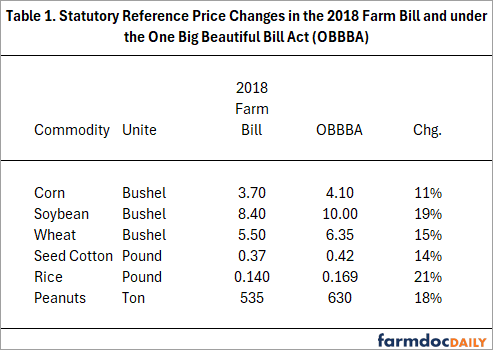
Farmdoc daily’s Gary Schnitkey, Nick Paulson, Jonathan Coppess and Carl Zulauf reported that “for the years up to 2031, statutory reference prices are increased from 2018 levels for all program crops. Corn’s reference price is increased from $3.70 to $4.10 per bushel, an increase of 11%. The soybean reference price was increased from $8.40 to $10.00 per bushel, an increase of 19%. Wheat’s statutory reference price was increased from $5.50 per bushel to $6.35, an increase of 15%. These statutory reference prices will remain in place through the 2030 crop year. Starting with the 2031 crop year, all statutory reference prices will be increased by 0.5% per year.”
Clayton reported that “addressing a long-time challenge with base acres, the legislation allows USDA to add up to 30 million new base acres tied to planting history from 2019-23. USDA will have to come up with a prorated formula for determining eligible acres that will be added to the commodity program. However, the law does not allow producers to reallocate their current base acres.”
“In addition, Congress made several changes to crop insurance, including expanding the Supplemental Coverage Option (SCO) to 90% coverage at the county level while boosting the federal subsidy to 80% of premium costs,” Clayton reported.
Timeline Unknown for Enrollment of Additional Base Acres
Brasher reported that “Fordyce also didn’t have a timeframe for implementing the provision that allows enrollment of an additional 30 million base acres. However, the rule addressed a key issue – what kind of non-program crops could be eligible for program base.”
“Under the rule, acreage that had been planted to a wide range of non-program commodities would be eligible with the exception of tobacco, marijuana and cover crops, as well as land enrolled in the Conservation Reserve Program,” Brasher reported. “Under the law, acreage in trees, bushes and vines also is ineligible.”
