



USDA is asking farmers and other stakeholders to help examine how USDA can improve its data collection and analysis. The department is issuing a Request for Information (RFI) to examine…
USDA Says 2025 Corn Production Hit 17 Billion Bushels, Likely to Keep Prices Low
Farm Futures’ Bruce Blythe reported that “corn futures plunged to the lowest levels since August after USDA stunned the market by boosting its 2025 U.S. crop estimate above 17 billion bushels for the first time, signaling a heavy supply outlook that likely will burden prices and further squeeze farmer bottom lines even amid record demand. Soybean futures also tumbled after USDA held its yield figure steady.”
“USDA said last year’s U.S. corn crop averaged a record 186.5 bushels per acre, up 0.5 bushel from a previous estimate, according to the agency’s annual Crop Production Annual Summary released (yesterday),” Blythe reported. “The average marked a 4% improvement over 179.3 bpa in 2024 and clashed with trade expectations for a downward revision of about 2 bpa.”
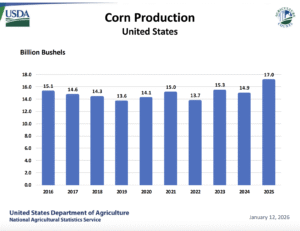
“USDA also raised harvested acreage 1.3 million acres to 91.3 million acres, resulting in a record crop totaling 17.021 billion bushels, up 269 million bushels from USDA’s previous estimate in November and up over 2 billion bushels, or 14%, from 2024,” Blythe reported. “USDA also raised its forecast for U.S. corn stocks at the end of the 2025-26 marketing year by 198 million bushels to 2.227 billion bushels, a seven-year high.”
“Today’s numbers ‘blindsided’ the market, painting a troubling picture for U.S. farmers struggling with crop prices that remain stubbornly below break-even levels and no apparent end in sight, said Jon Prischmann, President of Blue Creek Commodities and Hedging LLC in Fergus Falls, Minnesota,” Blythe reported. “‘Very surprising numbers today… and very ugly for corn,’ Prischmann said in an email. ‘Rallies will most likely now be quickly sold all the way into springtime unless something changes in the outside/world markets,’ he said. Heavy supplies and slumping prices ‘will make hedging going into summer very difficult for the rest of old crop and also new-crop December 2026.'”
Ag Groups Warn Production Number to Keep Prices Low
Progressive Farmer’s Todd Neeley reported that “shortly after USDA released its latest crop estimates on Monday, in which the agency bumped 2025 corn production to a record 17.02 billion bushels (bb), a national biofuels group and a commodity group sounded the alarm on what that much corn in the market could mean for U.S. farmers.”
“The National Corn Growers Association said on Monday the surplus supply promises to keep corn prices low as farmers struggle to pay high input costs,” Neeley reported. “‘We need long-term market solutions, and we need them quickly, or this is going to deepen the economic crisis in the countryside,’ said Ohio farmer and NCGA President Jed Bower. ‘The urgency for Congress and the president to open new markets abroad and expand consumer access to ethanol just increased exponentially.'”
The new supply projections from USDA underscore the urgency for developing long-term market solutions for corn growers.
Read more…https://t.co/Y9q5jhJFCQ
— National Corn (NCGA) (@NationalCorn) January 12, 2026
“The report (also) prompted the Renewable Fuels Association to renew its calls for permanent, year-round E15 nationally to boost corn demand,” Neeley reported. “‘Today’s surprise USDA report serves as a sobering wake-up call about the state of the farm economy and underscores the need for lawmakers to take immediate action to expand markets for America’s corn growers,’ said RFA President and CEO Geoff Cooper. ‘The fastest and easiest way to shore up the growing supply-demand imbalance in the corn market is to permanently remove the summertime barrier on E15 sales and eliminate obsolete fuel retail infrastructure rules. These decades-old regulatory barriers are literally choking off demand and shortchanging America’s farmers.'”
“Allowing year-round E15, he said, would create new demand for more than 2 billion bushels of corn and sorghum,” Neeley reported.
Corn Could Slide Below $4, Analyst Says
Farm Future’s Bryce Knorr reported that “despite the bearish production and demand numbers, USDA actually increased its average price forecast for corn by a dime to $4.10. My model suggests potential for the benchmark to slip below $4, perhaps all the way down to the $3.35 to $3.70 level, putting lows from the past two years into play.”
