



The Agriculture Department is anticipating a slightly easier 2026 for U.S. ag producers, with prices for major commodities nudging higher and input and labor costs moderating, according to USDA Chief…
USDA Seeks Input on Data Collection as Confidence Falls
Progressive Farmer’s Chris Clayton reported that “USDA is asking farmers and other stakeholders to help examine how USDA can improve its data collection and analysis.”
“There are growing questions over whether errors in USDA statistics come from changes no one could have predicted or if there are systemic issues with USDA’s data collection and reporting,” Clayton reported. “Agriculture Secretary Brooke Rollins announced (last) Friday at the USDA Agricultural Outlook Forum that the department is issuing a Request for Information (RFI) to examine USDA’s statistical data collection, analysis and research. The RFI posted Monday in the Federal Register.”
“In her speech, Rollins noted some of the goals of the Outlook Forum are to share USDA’s forecasts for the agricultural economy, commodity markets, trade and farm income,” Clayton reported. “‘None of these forecasts would be possible without the incredible work of the USDA economists and statisticians who collect and analyze this important data that has historically been considered the gold standard for market reporting,’ she said. Still, Rollins said there is room for improvement. Farmers around the country frequently question how numbers come together and what can be done to improve them.”
“‘We want to ensure at USDA that we are framing the status of the market, not driving price outcomes, and that will be a major effort over the next year,’ Rollins said,” according to Clayton’s reporting. “The RFI will include a 45-day comment period that will be used for feedback that USDA will discuss at its 2026 spring data users meeting on April 22 in Kansas City, Missouri.”
Producers, Economists and Retailers Say Confidence is Waning in USDA Data
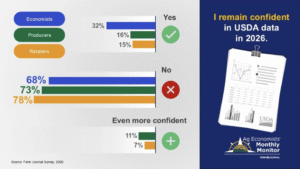
AgWeb’s Michelle Rook and Tyne Morgan reported that “confidence in USDA reporting is slipping across the agricultural economy, and it’s not just talk in the countryside. According to Farm Journal’s January Ag Economists’ Monthly Monitor, released at Top Producer Summit, the majority of economists, producers and retailers say their confidence in USDA reports has declined compared to past years.”
“68% of economists say they are less confident in USDA reports,” Rook and Morgan reported. “73% of producers say their confidence has declined. 78% of retailers report waning trust.”
“At the center of the discussion: A June acreage ‘miss’ and subsequent revisions left many in the industry questioning how such large shifts could occur in a short window and whether the data driving markets can be trusted,” Rook and Morgan reported. “…(Seth) Meyer, former USDA chief economist, acknowledges the issue. ‘Quite honestly, I think this is a problem,’ he says. ‘If you’ve lost confidence, we have to ask why.’ He emphasizes, however, the issue is not political interference or hidden agendas in USDA or the National Agricultural Statistics Service (NASS).”
“Instead, he pointed to structural challenges, including survey fatigue among producers and confusion about how acreage numbers are constructed and revised,” Rook and Morgan reported.
USDA Has Launched an Internal Review
Reuters’ Tom Polansek reported that “the U.S. Department of Agriculture, long the world’s gold standard for crop estimates, faces mounting doubts about the reliability of its data from farmers, grain traders and economists following deep staff losses and a sharp upward revision in how many acres of corn were harvested.”
“USDA’s final estimates in January for how many corn acres farmers planted and harvested in 2025 represented unprecedented increases from initial estimates in June. Already-low grain prices sank more than 5%, at a time when growers were struggling to make money,” Polansek reported. “…The revisions prompted USDA’s National Agricultural Statistics Service, which releases acreage estimates, to launch an internal review, said Lance Honig, a top NASS official.”
“As part of its review, USDA will confirm its procedures worked as they should, Honig said,” according to Polansek’s reporting. “The agency is also exploring options for improving harvested acreage estimates, most likely without more farmer surveys, he said.”
Clayton reported that “Deputy Secretary Stephen Vaden said USDA expects its data to be the best to ensure farmers have accurate information to make decisions about their operations.”
“‘Our data has to be the best, because if it is wrong, even if that error is — as I’m certain it would be — unintentional, then farmers may be making erroneous decisions because of things that we are telling them,’ Vaden said,” according to Clayton’s reporting. “At the end of the day, Vaden said, USDA economists’ job is to provide the truth, even if it is not what people want to hear. ‘Our economists’ job is not to be popular, it is merely to be right — because that’s what we ask of them,’ Vaden said.“
