



The Iran war has upended the planting intentions of U.S. farmers, resulting in fewer acres of corn and the lowest quantity of spring wheat planted since 1970 as rising fertilizer…
Ag Secretary Rollins Working Directly With Input Companies to Lower Prices
Agri-Pulse’s Oliver Ward, Kim Chipman, and Noah Wicks reported that “Agriculture Secretary Brooke Rollins says she is working directly with ag input companies to address rising prices amid mounting warnings over fertilizer supply and ongoing disruptions.”
“‘We want real relief for our farmers,’ Rollins told Fox News on Saturday. The president, she said, has tasked her with holding discussions with business leaders ‘to make sure that the farmers are seeing that relief,'” Ward, Chipman and Wicks reported. “The administration is grappling with high diesel and fertilizer prices, which shot up since the onset of the Iran war. Price and supply concerns are looming over planting season and dimming financial outlooks.”

“‘We’re now talking about this likely being not just a spring problem, but a fall problem,’ a fertilizer industry source told Agri-Pulse Friday,” according to Ward, Chipman and Wicks’ reporting. “Adding to the challenge is that while U.S. prices have climbed, they have not jumped as high as other countries, creating supply worries. If fertilizer companies can make more in other markets, the source said, ‘product is not going to flow here,’ the source said.”
Fertilizer and Fuel Prices Continue Increasing
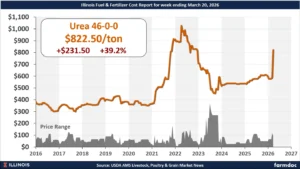
AgWeb’s Michelle Rook reported that “the conflict in the Middle East is having a negative impact on input costs. farmdoc daily recently reported significant price increases for various inputs, ranging from sulfate and DAP to diesel. These rising costs are further stressing profit margins that were already tight or even negative. Unfortunately, the recent improvement in corn prices is not enough to offset the increases.”
“farmdoc daily reports a significant spike in on-farm diesel fuel. Prices are now working toward the record levels seen in March 2022, according to Nick Paulson, professor of agricultural and consumer economics at the University of Illinois,” Rook reported. “‘If we look at diesel relative to last year, we’re looking at more than a $1 increase relative to where we were at,’ Paulson says. ‘An even bigger increase relative to some of the lows we were at prior to the conflict breaking out this year, closer to the $1.50 range in terms of that increase.'”
“Significant price hikes have also hit the fertilizer market. Currently, a quarter of global supplies pass through the Strait of Hormuz,” Rook reported. “Urea is the category most impacted, Paulson says, with prices up 39% in that class alone.”
The Associated Press’ Wyatte Grantham-Philips reported that “U.S. gas prices jumped past an average of $4 a gallon for the first time since 2022 on Tuesday as the Iran war pushed fuel prices to soar worldwide.”
“According to motor club AAA, the national average for a gallon of regular gasoline is now $4.02 — over a dollar more than before the war began. The last time U.S. drivers were collectively paying this much at the pump was nearly four years ago, following Russia’s invasion of Ukraine,” Grantham-Philips reported. “…In the immediate future, analysts point to groceries, which have to be restocked frequently and could also see price hikes as businesses’ transportation costs pile up.”
Trump Admin Moves to Lower Prices So Far Not Enough, Industry Says
E&E News’ Grace Yarrow reported earlier this month that “farmers and their Republican allies are worried that the White House isn’t doing enough to offer them economic relief as fertilizer prices spike because of the war in Iran.”
“President Donald Trump is making some moves aimed at bringing down fertilizer costs, like lifting sanctions on Venezuelan imports and waiving some shipping restrictions,” Yarrow reported. “But farm-state lawmakers and agriculture industry groups say those moves likely won’t be enough to avert food price spikes ahead of the midterms.”
“Despite urgent pleas from industry allies, the White House hasn’t outlined a clear path to bringing down fertilizer prices beyond reopening the Strait of Hormuz, where an Iranian blockade has choked off a vital passageway for fertilizer and fuel imports, according to three people familiar with the conversations,” Yarrow reported. “That’s bad news for congressional Republicans, who were already struggling to balance support for the president with midterm messaging when recent election results suggest affordability concerns may be front of mind for voters.”
“‘There’s no easy answer for this,’ said Sen. Jim Justice (R-W.Va.),” according to Yarrow’s reporting. “‘I think our president’s doing the right thing [in Iran], 100 percent. But, you know the old saying, with every action there’s an equal and opposite reaction. That’s what’s happening. … Our farmers are going to really be upside down now.'”
