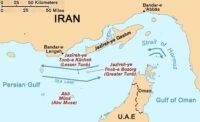


US President Donald Trump’s plan for a full naval blockade of the Strait of Hormuz threatens to deepen an already unprecedented crisis in one of the world’s most important energy-producing…
Attack on Iran Could Disrupt Global Fertilizer Markets
Agri-Pulse’s Kim Chipman and Oliver Ward reported that “a prolonged military conflict in the Middle East could potentially upend key commodity markets due to Iran’s control of the Strait of Hormuz, one of the world’s most important trade routes. America’s crop growers could see fresh price spikes for inputs like fertilizer while battling a multi-year downturn in profitability, experts warned ahead of the attack.”
“Prior to the attack over the weekend, certain fertilizer prices were near historic highs for this time of year, said Josh Linville, vice president of fertilizer at StoneX,” Chipman and Ward reported. “A military conflict ‘could be devastating’ for the global nitrogen and phosphate markets, Linville said in a note late last week prior to strikes on Iran by the U.S. and Israel. ‘If that strait shuts down, the world will focus on oil/gas/energy impacts, however, it would have a massive impact on nitrogen and phosphate values,’ he said.”
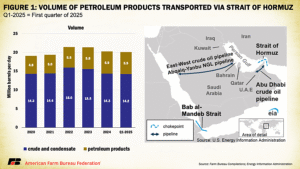
Forbes’ Robert Rapier reported that “globally, about 180 million metric tons of nitrogen fertilizers are consumed each year (measured in nutrient terms). Of that, roughly 55 to 60 million metric tons of urea move through international seaborne trade annually. The Middle East accounts for approximately 40% to 50% of that traded volume.”
“And nearly all of those exports must transit the Strait of Hormuz,” Rapier reported. “In other words, close to one-quarter of globally traded nitrogen fertilizer—and a meaningful share of total global nitrogen production—moves through that single maritime chokepoint that is now threatened by war.”
Our chart of the week shows the volume and share of #urea trade through the Strait of Hormuz #nitrogen #fertilizer pic.twitter.com/lS5lt7OHMo
— Fertilizer Week (@FertilizerWeek1) February 25, 2026
“Unlike oil, fertilizer markets lack a meaningful strategic buffer. The United States maintains a Strategic Petroleum Reserve with hundreds of millions of barrels of crude. There is no equivalent stockpile of nitrogen fertilizer ready to offset a prolonged disruption,” Rapier reported. “Fertilizer trade operates largely on a just-in-time basis. Seasonal demand spikes align with planting cycles, and inventories are not built to absorb major geopolitical shocks.”
Ship Traffic at Strait of Hormuz Currently Disrupted
The Associated Press’ David McHugh reported that “oil prices rose sharply Monday as disruptions in tanker traffic through the Strait of Hormuz chokepoint raised uncertainty about how U.S. and Israeli attacks on Iran would affect supply to the world economy.”
“A key focus was the situation around the strait at the southern end of the Persian Gulf, through which 20% of the world’s oil supply passes,” McHugh reported. “Tanker traffic dropped sharply amid disruption of satellite navigation systems, data and analytics firm Kpler said on X, while the UK Maritime Trade Operations Centre reported attacks on several vessels in the area on either side of the strait and warned of elevated electronic interference to systems that show where ships are.”
“A bomb-carrying drone boat struck a Marshall Islands-flagged oil tanker in the Gulf of Oman on Monday, killing one mariner on board, Oman said,” McHugh reported. “Iran has been threatening vessels approaching the Strait of Hormuz and is believed to have launched multiple attacks.”
Soybean Oil Surges After Strikes
Bloomberg’s Ben Westcott and Anuradha Raghu reported that “soybean oil jumped to the highest level in more than two years, tracking crude prices higher after strikes by the US and Israel on Iran over the weekend.”
“Futures in Chicago surged as much as 3.9% on Monday before paring some gains, though the most-active contract remains on track to advance for a sixth session. Benchmark palm oil prices in Kuala Lumpur climbed 1.6%,” Westcott and Raghu reported. “The rally in energy markets supported the move as higher crude prices usually make other fuel sources such as biodiesel more attractive and boost demand for vegetable oils.”
“‘It will be like a magnet with crude oil this week following the attacks in Iran,’ said Joe Davis, director at brokerage Futures International LLC, referring to soy oil prices,” Westcott and Raghu reported.
Where the War Currently Stands
CBS News’ Tucker Reals reported that “the war launched by the U.S. and Israel on Iran entered its third day with more Iranian missile attacks directed at Israel and its Arab neighbors. The strikes have killed three U.S. service members in Kuwait and at least 11 people in Israel. The Iranian Red Crescent says 555 people have been killed in Iran.”
“Air travel is snarled as the war forces the closure of key hub airports in the Mideast, leaving tens of thousands of people stranded in the Gulf region — as the U.S. declines to join other countries planning to help evacuate their citizens,” Reals reported. “President Trump said Sunday that the joint military operation would continue ‘until all of our objectives are achieved,’ and that could be ‘four weeks or less,’ but that more American casualties are possible.”

Related News Summaries