



Fertilizer producers Mosaic and Simplot say they support keeping countervailing duties on Moroccan and Russian phosphate fertilizer in the five-year review now underway. If the domestic industry had said it…
China Signals Openness to Buying More US Ag Products
Reuters’ David Lawder reported that “top U.S. and Chinese economic officials held ‘remarkably stable’ talks in Paris on Sunday that touched on potential areas of agreement in agriculture, critical minerals and managed trade for U.S. President Donald Trump and Chinese President Xi Jinping to consider in Beijing, two sources familiar with the talks said.”
“The Chinese side showed openness to potential additional purchases of U.S. agricultural goods including poultry, beef and non-soybean row crops, one of the sources said, adding that China was still committed to buy 25 million metric tons of American soybeans for each of the next three years,” Lawder reported. “Chinese officials left the talks at OECD headquarters in Paris without speaking to reporters. The discussions follow several meetings to ease tensions last year between (U.S. Treasury Secretary Scott) Bessent, (Chinese Vice Premier He Lifeng), U.S. Trade Representative Jamieson Greer and Chinese chief trade negotiator Li Chenggang.”
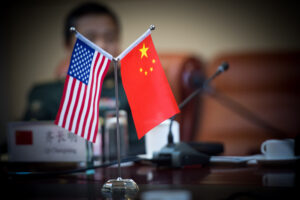
“‘All these meetings were to create stability, and today was remarkably stable,’ one of the sources said of the talks,” Lawder reported. “Spokespersons for the U.S. Treasury and the U.S. Trade Representative’s office declined to characterize the discussions on Sunday.”
Trump May Delay Meeting with China’s Xi Jinping
The Associated Press’ Will Weissert reported, however, that “President Donald Trump is suggesting he may delay his much-anticipated visit to China at the end of the month as he seeks to ramp up the pressure on Beijing to help reopen the Strait of Hormuz and calm oil prices that have soared during the Iran war.”
“In an interview Sunday with the Financial Times, Trump said China’s reliance on oil from the Middle East means it ought to help with a new coalition he is trying to put together to get oil tanker traffic moving through the strait after Iran’s threats have throttled global flows of oil,” Weissert reported. “The Republican president said ‘we’d like to know’ before the trip whether Beijing will help. ‘We may delay,’ he said in the interview.”
“The uncertainty underscores just how much the U.S.-Israeli strikes on Iran have reshaped global politics in the past two weeks,” Weissert reported. “Calling off the face-to-face visit with Chinese President Xi Jinping could have its own major economic consequences: Relations between Washington and Beijing have been fraught as both sides have threatened the other with steep tariffs over the past year.”
Soybeans Could Still Be a Point of Discussion in Talks
Bloomberg’s Hallie Gu reported before the talks that “soybeans are likely to be on the agenda when trade chiefs from the U.S. and China next meet, a conversation that could shed light on when Beijing plans to resume purchases in earnest.”
“After a months-long trade war in 2025 cut Chinese purchases to zero, Beijing quickly made good on its agreement in October to buy 12 million tons of U.S. beans. But purchases have since stalled. Expectations on when they might pick up aren’t clear-cut, and the war in Iran has made geopolitical conditions much stormier,” Gu reported. “The truce between Washington and Beijing projected annual imports of 25 million tons for the three years from 2026. Having cleared the initial 12-million-ton hurdle, traders thought Chinese buyers might pause until the new U.S. crop becomes available from September, when prices are often most attractive.”
“But Trump has since fueled expectations that more beans could be bought earlier, after posting on his Truth Social account in February that China is considering lifting purchases to 20 million tons in the current season,” Gu reported. “China hasn’t commented on any of the agreements, nor on Trump’s post, so what happens next is unclear.”
“‘The market appears to be dialing back expectations for a major trade breakthrough,’ said No Bull Ag analyst Susan Stroud,” according to Gu’s reporting. “‘The Middle East conflict has injected fresh uncertainty and shifted focus away from China.'”
