



The U.S. Department of Agriculture already has obligated more than $6 billion in payments under its new Farmer Bridge Assistance program just days after enrollment opened.
Most Rented Farmland Owned by Non-Farmers, USDA Says
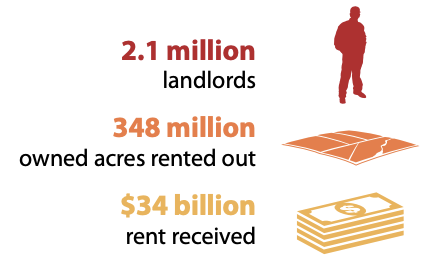
Progressive Farmer’s Todd Neeley reported that “the vast majority of over two million landowners who rented out 347.8 million acres of agricultural land in 2024 were non-farming landlords, according to the latest USDA survey data, while the amount of land rent collected has increased since 2014.”
“The 2024 Tenure, Ownership and Transition of Agricultural Land survey results released by USDA’s National Agricultural Statistics Service, showed 79% of the acres are owned by non-farming landlords,” Neeley reported. “Non-operating landlords include entities who rent out agricultural land under a variety of ownership arrangements including privately owned, trust, family entity, non-family entity or other.”
“Of the land rented out by non-operating landlords, over 251 million acres were rented out by private landowners, trusts or family entities,” Neeley reported. “…Rented farmland acres combined with buildings on this land are valued at more than $1.6 trillion, according to the NASS survey. In 2024, landlords combined received $34.1 billion in rental income, which is 9% higher compared to 2014. Landowners also incurred about $12 billion in total operating expenses.”
RFD-TV’s Marion Kirkpatrick reported that “regionally, the Plains hold the largest share of rented farmland at about 149 million acres — 43 percent of the total. The Midwest has the most landlords, with nearly 800,000 managing rental ground.”
“The survey also collected demographic information on the 1.8 million non-farming entities, also known as principal landlords. The average age of these landlords is 69.2 years old, according to the survey. That exceeds the age of the average farmer, who is 58.1 years old, according to the 2022 Census of Agriculture,” Neeley reported. “Just 12% of all principal landlords were under 55 years old while nearly 52% of all the principal landlords have never farmed.”
Only 5% of US Farmland to Hit the Market in Next 5 Years
Farm News Media reported that “new estimates from USDA paint a bleak picture for anyone in the market for farmland in the next five years. According to National Agricultural Statistics Service (NASS), about 5% of the nearly 900 million U.S. farmland acres — or about 43 million acres — is slated for ownership transfer in the next five years, not including farmland that is in or is expected to be put into wills or trusts.”
“Only 23 million acres of land are expected to be sold to a non-relative, while 20 million acres are expected to be sold to a relative or given as a gift,” Farm News Media reported. “‘This means that only a small percentage of farmland will be available for purchase,’ USDA wrote as part of its findings for the most recent results of its Tenure, Ownership, and Transition of Agricultural Land (TOTAL) survey.”
AgWeb’s Margy Eckelkamp reported that “limited inventory of land available for sale continues to support land values. And it’s juxtaposed with economists saying cash rent acre expansion comes at too high of a cost with low commodity prices and high input prices. There’s not enough returns on corn and soybean production to provide both the landowner and the farmer with historical ‘normal’ returns.”
“Looking at a shorter time horizon, the latest Farm Journal research shows nearly 15% of American cropland is projected to be ‘at risk’ of changing hands within the next three years — including operations that downsize, sell, change management or change ownership through a will, trust, or other transference,” Eckelkamp reported. “Farm Journal data identifies the Midwest as the epicenter of this shift, with roughly 12 million acres likely to transition. Nationwide, that total reaches a staggering 44 million acres.”
