



The Iran war has upended the planting intentions of U.S. farmers, resulting in fewer acres of corn and the lowest quantity of spring wheat planted since 1970 as rising fertilizer…
Prolonged Iran War Could Shrink US Corn Acres, Analysts Say
Reuters’ Naveen Thukral and Ed White reported that “the world’s farmers face soaring fertilizer and fuel prices as the war in the Middle East escalates, leaving some scrambling for supplies as the spring planting season approaches.”
“Prices in the United States, which imports much of its fertilizer needs despite a large domestic industry, rose at the war’s outbreak,” Thukral and White reported. “Prices for fertilizer jumped from $516 per metric ton on Friday to up to $683 at the import hub of New Orleans on Thursday. Prices could jump higher if the Persian Gulf closure persists and shipments can’t make it in time for spring planting, analysts told Reuters. ‘Literally, this could not happen at a worse time of the year,’ said StoneX analyst Josh Linville.”
“Seth Meyer, former U.S. Department of Agriculture chief economist and now at the Food and Agricultural Policy Research Institute, said farmers might alter crop choices and fertilizer applications due to the price spike,” Thukral and White reported. “Farmers need fertilizers for virtually all their crops if they want a good yield, but each crop and the soil they are grown in have different demands. Farmers could cut back on corn, which requires high rates of nitrogen fertilizer, or else sharply reduce fertilizer application rates, Meyer said.”
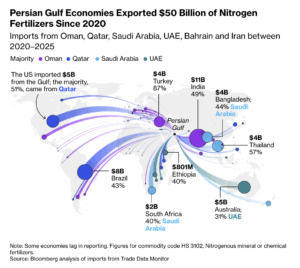
AgWeb’s Tyne Morgan reported that “the most significant planting implications may fall on corn. Corn is far more fertilizer-intensive than soybeans, particularly when it comes to nitrogen. When fertilizer prices rise sharply, the relative profitability of soybeans often improves quickly. That dynamic was already influencing acreage expectations even before the conflict escalated.”
“‘Now with the fertilizer situation and the effects of the war, I think you could see additional acres move out of corn to beans,’ (Chip Nellinger, founder and partner of Blue Reef Agri-Marketing) says. ‘Particularly on the fringe areas,’” Morgan reported. “He doesn’t expect the shift to dramatically alter planting plans in the highest-producing Corn Belt counties. ‘Maybe not so much in the 50 or 60 million acres right in the heart of the I-states with the highest-yielding ground,’ he says.”
“But outside those core areas, the economics could push growers toward soybeans,” Morgan reported. “‘Certainly away from that area, it could be a definite impact on acreage,’ says Nellinger. “The situation has caused (Dan Basse, founder and president of AgResource) to already adjust his acreage projections accordingly. ‘I’ve taken my corn planting estimate down about a million to a million and a half acres relative to the war and fertilizer,’ he says.”
“Before the conflict escalated, his projection called for roughly 94.5 million acres of corn. ‘So I was at 94.5,’ Basse says. ‘Now down around 93 to 93.5,'” Morgan reported. “At the same time, he’s increasing expectations for soybean plantings. ‘I’ve taken my bean acreage estimate up to 86.5 or 87,’ he says. ‘So we have made adjustments.'”
Bloomberg’s Michael Hirtzer, Ben Westcott, Agnieszka Barteczko, Anuradha Raghu, and Hayley Warren reported that “facing the prospect of a prolonged conflict, some are rethinking their planting prospects. American soy and corn farmer Brad Feckers said he’s been planning to sow two-thirds of his farm in Shell Rock, Iowa with corn, but the conflict has him worried about rising nitrogen costs and could leave him pulling back on corn, which requires more fertilizer. ‘If nitrogen doesn’t come down, we might switch more acres to beans,’ he said.”
Crop Prices Surge
Bloomberg’s Hallie Gu and Eko Listiyorini reported that “palm oil surged as much as 10%, soybean oil jumped and wheat neared a two-year peak, as the war in the Middle East drove energy and fertilizer costs higher and threatened to tighten supplies across agricultural markets.”
“Disruptions to crude oil supplies wrought by the conflict are boosting the appeal of crop-based biofuels, lifting demand for vegetable oils and corn,” Gu and Listiyorini reported. “The effective closure of the Strait of Hormuz — a major conduit for the fertilizer trade — has also led to a spike in the price of crop nutrients as farmers rush to secure supply. In addition, wartime food security concerns could spark some countries to stock up on staples like wheat.”
“Palm oil jumped the most since 2022, when top grower Indonesia halted exports. Chicago futures of soybean oil, palm’s closest substitute, rose as much as 5%, up for an 11th day and headed for the longest run of gains since 2008,” Gu and Listiyorini reported. “Wheat futures rallied more than 3%, after jumping the most since 2024 on Friday, while corn climbed over 2% and soybeans also rose.”
