



The House Agriculture Committee advanced the Republican-led farm bill in a 34-17 vote early Thursday after a marathon markup that was clouded by partisan fighting about the package.
Senate Dems Seek to Break Up Meatpacking Industry
Bloomberg’s Ilena Peng and Leah Nylen reported that “the US meatpacking industry faces a fresh wave of scrutiny, this time from Senate Democrats seeking to allow companies to process only one type of meat and set stricter limits on the beef market.”
“The bill, introduced Thursday by the Senate’s top Democrat, Chuck Schumer of New York, comes at a time when record consumer beef prices have become a flashpoint of voter anger over food inflation heading into November’s US midterm elections. President Donald Trump also last fall asked the US Justice Department to investigate the industry,” Peng and Nylen reported. “‘It’s not right for a single company to have the power to dominate beef, pork, chicken all at once,’ Schumer said at a news conference unveiling the legislation.”
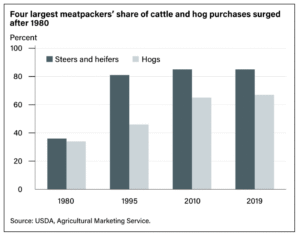
“The meatpacking industry has long faced bipartisan scrutiny due to high levels of concentration. The country’s top four beef packers buy more than 80% of cattle, while a separate group of pork processors account for about two-thirds of hog purchases, according to the US Department of Agriculture,” Peng and Nylen reported. “Those levels of concentration are higher than when the US first took action against the meatpacking industry in the 1920s, Schumer noted.”
“The bill would limit major meatpacking conglomerates to one major type of meat, such as beef, pork or poultry, and impose limits on beef market concentration at both regional and national levels,” Peng and Nylen reported. “…The bill limits sales arrangements between a single feedlot and a packer, which critics argue can be the functional equivalent of ownership. The US Federal Trade Commission also would regain authority over meatpacking and agricultural markets, which Congress stripped from the agency in the 1930s, leaving only the Justice Department to provide federal antitrust oversight of those markets.”
“The lawmakers also said foreign-owned companies like Brazil’s JBS NV will be required to divest US assets, while ordering a ‘comprehensive study’ of other foreign-controlled firms like Smithfield Foods Inc. and its recent acquisitions,” Peng and Nylen reported. “The Virginia-based pork processor, which is owned by Hong Kong’s WH Group Ltd., earlier this year bought hot dog brand Nathan’s Famous.”
Experts Say the Legislation Would Be Bad for Producers and Consumers
Agri-Pulse’s Noah Wicks reported that “Glynn Tonsor, an economist at Kansas State University, told Agri-Pulse that larger cattle plants generally can harvest an animal more cheaply than smaller ones, often as a result of different procedures and labor distributions. He said if restrictions are set on size and ownership, it would limit some of the ‘economies of scale’ benefits that larger beef processors have been able to provide.”
“Derrell Peel, a professor of agricultural economics at Oklahoma State University, said consolidation has occurred because it’s ‘cost effective.’ If the meatpackers were broken up, ‘you will lose that cost efficiency,’ which will raise costs in the middle of the industry, above producers and below consumers. When those costs rise, he said consumers tend to pay more, and producers tend to get paid less,” Wicks reported. “…’This is a horrible idea,’ he said of the proposal. ‘It will make prices for consumers go higher. It will make cattle prices … go lower, and it will infinitely extend the amount of time it would take to rebuild this industry to get to a point where there would be larger supplies.'”
Progressive Farmer’s Chris Clayton reported that “‘this proposal is absurd,’ said Julie Anna Potts, president and CEO of the Meat Institute, the lobby group for the packing industry.”
“Schumer’s bill would ‘destroy the meatpacking industry’ and would drive up protein prices for consumers, along with hurting livestock and poultry producers, and union jobs, the Meat Institute stated. Potts said the bill amounts to ‘reckless election-year pandering’ that puts the industry at risk,” Clayton reported. “‘Such a foolish proposal would never even be considered in another industry,’ Potts said. ‘Imagine the federal government mandating that Ford only manufacture trucks, while forcing them to sell off all their other vehicle lines to separate small businesses. It is unthinkable in a free market. They don’t even do that in Russia anymore.'”
