



U.S. agriculture equipment maker Deere on Monday agreed to pay $99 million into a settlement fund for farms and farmers that are part of a class action over costs and…
Farmer Sentiment Improves in March Despite Iran War Cost Increases
U.S. farmer sentiment improved in March despite fuel and fertilizer cost increases due to the Iran war, according to the newest Purdue University-CME Group Ag Economy Barometer Index. The barometer rose for the second straight month in March, reaching 127 points, up from 116 in February. However, the barometer remains below levels from a year ago.
World-Grain’s Arvin Donley reported that “the percentage of respondents who cited high input costs as their biggest concern increased from 44% to 46% this month. However, the percentage of respondents who think the United States is headed in the ‘right direction’ and who expect land prices to be higher five years from now also increased. The March barometer survey was conducted among 400 farmers across the nation from March 16-20.”
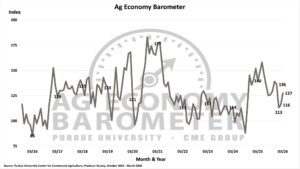
“Approximately 18% of respondents indicated that their farm operations were better off in March than they were a year ago,” Donley reported. “Looking ahead, 18% expected worse financial performance over the next 12 months, compared to 20% who expected better financial performance. The Farm Capital Investment Index rose by 3 points to 53. However, only 4% of survey respondents indicated that they plan to increase farm machinery purchases in the upcoming year.”
Capital Press’ Kyle Odegard reported that “only 37% of producers expect good times in the next five years, however, lower than the response from a year prior. The survey continued to highlight a sharp divide between crop and livestock producers. While 63% of livestock producers anticipated good times, that figure was 31% for growers.”
“‘While producers are feeling more optimistic about the future, there’s still a noticeable gap between short-term challenges and long-term confidence,’ said Michael Langemeier, the barometer’s principal investigator and director of Purdue’s Center for Commercial Agriculture. ‘Longer-term optimism is supported by stronger expectations for farmland values and the broader economy, though livestock producers remain notably more optimistic than crop producers.'”
Survey Reflects Continued Consideration of Solar
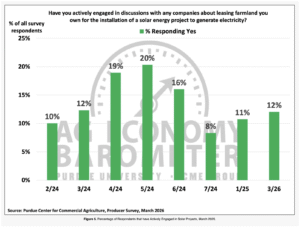
Purdue’s Morgan French reported that “the March survey also included questions about leasing farmland for solar energy production. Twelve percent of producers reported discussing a solar lease within the past six months. Reported lease rates varied widely, with roughly 21% exceeding $1,500 per acre. More than half of respondents (56%) said contract offers included an escalator clause, most commonly in the 2% to 3% annual range. Overall, 5% of respondents indicated that they or one of their landowners had signed a solar lease. ”
AgWeb’s Chris Bennett reported that “in 2021, President Biden (Executive Order 14057) mandated that the federal government reach net-zero carbon emissions by 2050. A massive solar push was included in the plan. How much farmland was needed to reach the net-zero goal? Estimates ranged from 10 million to 26 million acres, with upper end projections of 50 million.”
“However, in 2025, President Trump signed Executive Order 14148, revoking Biden’s mandate,” Bennett reported. “In 2024-2025, solar infrastructure covered approximately 1 million-plus acres of farmland, with roughly half of the acreage directly on cropland. Overall, the U.S. contains almost 880 million acres of farmland.”
Producers Also Remain Concerned about Inflation
French reported that “this month’s survey also examined producer expectations for inflation and interest rates. Approximately 39% of respondents stated that they expect inflation for consumers to exceed 3%. When asked whether the U.S. prime interest rate would be lower, about the same or higher 12 months from now, 34% of producers anticipate lower interest rates, while 16% said they expect rates to be higher.”
