



The Iran war has upended the planting intentions of U.S. farmers, resulting in fewer acres of corn and the lowest quantity of spring wheat planted since 1970 as rising fertilizer…
Farmers Will Plant Less Corn and More Soy in 2026, USDA Says
Farm Progress’ Bruce Blythe reported that “as far as American farmers are concerned, ‘King Corn’ will retain its crown for another year. That’s one takeaway from today’s USDA Prospective Plantings report, which included an unexpectedly high corn acreage forecast at 95.338 million acres. That figure marks a 3.4% drop from last year’s plantings, which were a nine-decade high, but was about 967,000 acres above the average analyst estimate.”
“The same report showed estimated soybean plantings at a lighter than expected 84.7 million acres, up 4.3% from 2025’s six-year low but about 849,000 acres short of the average estimate,” Blythe reported. “USDA’s acreage estimates suggest many farmers see greater profit potential in corn compared to soybeans and other crops even after last year’s record 17.02 billion-bushel harvest swelled supplies to multi-year highs. This year’s expected planted acreage would be the fourth highest since the end of World War II and could generate a near-record harvest if weather cooperates.”
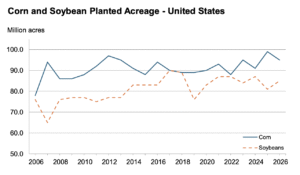
“Analysts cautioned that USDA’s acreage numbers are preliminary and, because results were gathered during the first half of the month, may not fully reflect the impact of the Middle East war that sent fertilizer prices soaring,” Blythe reported. “Spring weather could also alter acreage decisions. USDA will update its acreage numbers at the end of June.”
“‘That will be the debate within the industry: Has the farmer changed his outlook or his planting intentions after he submitted his (survey), simply because the price of fertilizer continues to move higher as well as the cost of energy in general,’ (Jim McCormick, chief operating officer at AgMarket.Net) said,” according to Blythe’s reporting. “‘Remember, this is just the beginning point of the story. We still need to see what gets planted.'”
USDA Survey Response Rate Lowest Ever for March
Blythe reported that “USDA’s acreage estimates were based on mail, phone and internet surveys of about 73,800 farm operators during the first two weeks of March, the agency said.”
But the response rate to the March surveys appear to have been hit by growing discontent the agriculture industry has had in recent months to USDA data in general. Lance Honig, chair of the Agricultural Statistics Board at NASS, said on the social media platform X that the response rate to the acreage estimate surveys was just 37.6%, which was down from 44.3% last year and the lowest ever for the March survey.
In mid-February, Farm Journal’s January Ag Economists’ Monthly Monitor found that the vast majority of economists, producers and retailers said they are less confident in USDA reports than they used to be. That was seen again on social media after the release of the March Prospective Plantings and Grain Stocks reports yesterday, with users sharing their distrust of those reports or saying they were disappointed not to have received a survey.
The University of Missouri’s Seth Meyer said on X that shows that the relationship between USDA data gatherers and U.S. producers needs rebuilding, as the USDA data remains crucial for farmers. “I’m not sure how to express to everyone the importance of this partnership for producers,” he said. “Let me assure you, large Agri business firms will exploit any information gap that results.”
Corn and Soybean Stocks up from 2025
Progressive Farmer staff reported that “corn stocks in all positions on March 1 totaled 9.02 billion bushels, up 11% from a year ago.”
“Of total stocks, 5.43 billion bushels were stored on farms, up 21% from a year earlier. Off-farm stocks were 3.59 billion bushels, down 2% from last year. The December 2025–February 2026 indicated disappearance, or usage, was 4.28 billion bushels, compared with 3.93 billion bushels for the same quarter a year ago,” Progressive Farmer reported. “The quarterly stocks for corn are a record for March, going beyond 2018’s 8.9 billion bushels.”
“Soybeans stored in all positions on March 1 were 2.1 billion bushels, up 10% from March 1, 2025. Of all stocks, 900 million bushels were stored on farms, up 3% from last year,” Progressive Farmer reported. “Off-farm stocks were 1.2 billion bushels, up 16% from last year. The indicated usage from December 2025-February 2026 totaled 1.18 billion bushels, down 1% from the same period a year ago.”
