



U.S. farmer sentiment improved in March despite fuel and fertilizer cost increases due to the Iran war, according to the newest Purdue University-CME Group Ag Economy Barometer Index. The barometer…
Iran Ceasefire Won’t Provide Immediate Fertilizer Relief
Farm Progress’ Joshua Baethge reported that “the world breathed a sigh of relief Tuesday night in response to news that the U.S. and Iran had agreed to a two-week ceasefire. Included in the deal was a commitment from Iran to reopen the Strait of Hormuz. That doesn’t mean an immediate return to normal fertilizer shipments.”
“According to Deepika Thapliyal, a global fertilizer analyst with the Independent Commodity Intelligence Services, the limited reopening of the strait has taken some of the immediate panic out of the fertilizer market. Still, a two-week ceasefire is not enough to change the bigger picture,” Baethge reported. “Shipping remains far from normal. Nobody knows how much fertilizer material will move out of the strait. Also far from clear is how long the ceasefire will actually hold.”
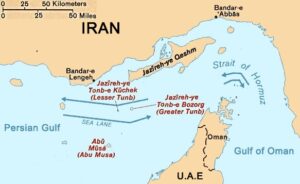
“‘Even with the strait technically open, cargoes may face delays and elevated war risk insurance, so a full return to normal trade is likely to take weeks or even months, assuming the ceasefire stays intact,’ Thapliyal said,” according to Baethge’s reporting. “‘And people want to exit the Strait of Hormuz. Even with a ceasefire, no one will want to enter the strait with their ships unless things return closer to normal.'”
Agri-Pulse’s Oliver Ward reported that “backlogged deliveries of fertilizer and fuel could take months to clear, Tim Lang, a professor of food policy at City University London, said. ‘You don’t suddenly transport hundreds of thousands of tons of oil or urea or fertilizer or liquid gas and it jet hops to where it should have been five weeks ago,’ Lang argued.”
Fertilizer Prices Continue to Spike
Progressive Farmer’s Russ Quinn reported that “retail fertilizer prices continue to jump, in some cases by double-digits — one of them by more than 30%. According to prices tracked by DTN for the last week of March 2026, all eight of the major fertilizers are higher compared to last month for the second week in a row.”
“Five of the eight major fertilizers had considerable price increases compared to prior month. DTN designates a significant move as anything 5% or more,” Quinn reported. “Urea led the way higher again as the nitrogen fertilizer was a whopping 34% higher compared to last month. The liquid fertilizer had an average price of $838/ton.”
Everyone is wanting to know: what are nitrogen prices doing in response?
Market has been quiet as everyone tries to figure out the new normal. Best indication:
April NOLA urea barges are down 7.5% from yesterday’s last trade which was 3% higher than Monday.
— Josh Linville (@JLinvilleFert) April 8, 2026
“Both UAN28 and UAN32 were 21% higher than a month ago. UAN28 had an average price of $496/ton, while UAN32 was at $564/ton,” Quinn reported. “Anhydrous was 18% higher than the prior month and had an average price of $1,060/ton. 10-34-0 was 8% more expensive than last month and had an average price of $714/ton. The remaining three nutrients were slightly higher in price compared to last month. DAP had an average price of $863/ton, MAP was $917/ton and potash $489/ton.”
Farmer Fertilizer Concerns Extend to 2027
World-Grain’s Arvin Donley reported that “US corn farmers are facing growing uncertainty around fertilizer affordability and access, with concern mounting well beyond the current planting season, according to survey results released on April 8 by the National Corn Growers Association (NCGA).”
“Findings from two nationwide surveys conducted in late March reveal that while many growers secured fertilizer supplies for the 2026 crop before recent global disruptions intensified, anxiety about fertilizer pricing and availability is rapidly accelerating — particularly for the 2027 crop year,” Donley reported. “‘Fertilizer prices were high even before the war in Iran began,’ said Jed Bower, Ohio farmer and president of the NCGA. ‘Added market stress due to the Strait of Hormuz closure has only intensified an already difficult situation, particularly as we look towards 2027.'”
“For every farmer expressing greater concern about fertilizer prices and availability for 2026, nearly two farmers report heightened concern for 2027, the surveys found, underscoring that today’s market volatility already is shaping decisions well beyond this season,” Donley reported.
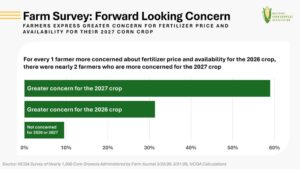
“Beyond rising costs, the survey found that farmers increasingly are worried about whether fertilizer will be available when they need it. Global shipping disruptions and reports of curtailed fertilizer production in several countries are tightening supplies and heightening uncertainty across markets,” Donley reported. “…While near-term supplies for spring 2026 appear relatively stable for many producers, survey responses made clear that concern intensifies looking ahead. Fertilizer supply chains operate on long timelines, and disruptions today could compound into tighter supplies later this year — precisely when farmers begin securing inputs for the 2027 crop.”
