Bloomberg’s Greg Stohr reported that “the US Supreme Court gave Bayer AG a mixed reception on its bid to stop tens of thousands of lawsuits claiming its Roundup herbicide should have been labeled as a cancer risk. Hearing arguments in Washington Monday, the justices weighed a $1.25 million jury verdict won by a Missouri man who blamed Roundup for his non-Hodgkin lymphoma. The company contends that since US regulators didn’t require a cancer warning, federal law bars the Missouri suit and others like it.”
“Bayer drew supportive comments from Justice Brett Kavanaugh, who questioned whether lawsuits alleging a failure to warn could be squared with a provision in federal law requiring ‘uniformity’ in herbicide labels,” Stohr reported. “But Chief Justice John Roberts suggested that states considering new evidence that a product is risky should be allowed to ‘call this danger to the attention of the people.'”
“Bayer is looking to put an end to litigation that has cost the company more than $10 billion and depressed its stock price,” Stohr reported. “A ruling favoring the German company could also help the medical-device, cosmetic and food industries, which are governed by laws similar to the one at the center of the Bayer case. The court will rule by early July.”
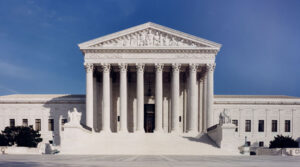
Progressive Farmer’s Todd Neeley reported that “Paul Clement, a former U.S. solicitor general representing Bayer in the case, reiterated before the court that federal law preempts state failure-to-warn claims. ‘Here, a Missouri jury imposed a cancer warning requirement that the EPA does not require,’ Clement told the court. ‘That additional requirement is preempted.'”
“Bayer argued that when EPA registers a pesticide and approves a label, it creates a binding federal requirement,” Neeley reported. “…Bayer also argued that a pesticide registrant cannot add a cancer warning without EPA approval, essentially making it impossible to comply with federal and state laws simultaneously.”
“Ashley Conrad Keller, the attorney for the respondent in the case, argued that (the Federal Insecticide, Fungicide and Rodenticide Act’s) registration process does not create a binding label requirement — pointing to a prima facie evidence clause that limits the preemptive force of registration,” Neeley reported. “Keller pointed to the 2005 Supreme Court case Bates v Dow Agrosciences to support his argument. In that case, the court ruled 7-2 that FIFRA does not preempt state-law damage claims against chemical manufacturers.”
“Typically, it’s difficult to determine which way the court leans in cases based on the oral arguments. The trio of justices, including Ketanji Brown Jackson, Sonia Sotomayor and Elena Kagan, pressed Bayer’s attorney Clements the hardest,” Neeley reported. “…On the flipside, Justices Brett Kavanaugh, Clarence Thomas and Samuel Alito did not press Bayer during the oral arguments, while Justice Amy Coney Barrett and Chief Justice John Roberts didn’t seem to indicate that they were leaning either way. Justice Neil Gorsuch didn’t ask any substantive questions during the hearing.”
MAHA Rallies Against Pesticides During Hearing
Reuters’ Leah Douglas reported that “‘Make America Healthy Again’ activists rallied at the U.S. Supreme Court building on Monday against Bayer as the justices heard arguments in the German company’s effort to end thousands of lawsuits that allege its weedkiller Roundup causes cancer.”
“A couple of hundred MAHA supporters cheered and chanted on the sidewalk outside the neoclassical white marble edifice during a rally called ‘The People vs. Poison,’ waving signs with slogans such as ‘No Immunity for Poison’ and ‘How Much Cancer is Acceptable?'” Douglas reported. “The name MAHA is a modification of President Donald Trump’s ‘Make America Great Again’ slogan. But speakers at the rally criticized the Trump administration’s support for Bayer in this case as well as the use of pesticides in agriculture.”
‘Make America Healthy Again’ activists rallied against Bayer as the US Supreme Court heard arguments in the German company’s effort to end lawsuits that allege its weedkiller Roundup causes cancer https://t.co/7Dn03WA64w pic.twitter.com/iWOkKxYlPv
— Reuters (@Reuters) April 28, 2026
“‘You cannot make America healthy again and protect the corporations that are poisoning us,’ Vani Hari, a MAHA activist and author who spoke at the rally, told Reuters,” according to Douglas’ reporting.
Bayer Previously Proposed a $7.25 Billion Roundup Settlement
The Associated Press’ David A. Lieb reported that “agrochemical maker Bayer and attorneys for cancer patients announced a proposed $7.25 billion settlement (in February) to resolve thousands of U.S. lawsuits alleging the company failed to warn people that its popular weedkiller Roundup could cause cancer.”
The case just heard by the Supreme Court “would not be affected by the proposed settlement,” Lieb reported. “But the settlement would eliminate some of the risk from an eventual Supreme Court ruling. Patients would be assured of receiving settlement money even if the Supreme Court rules in Bayer’s favor. And Bayer would be protected from potentially larger costs if the high court rules against it.”
“The newly proposed nationwide settlement is designed to address most of the remaining lawsuits (against Bayer), as well as any additional cases brought in the coming years by people who were exposed to Roundup before Tuesday,” Lieb reported. “If too many plaintiffs opt out of the proposed settlement, Bayer said it reserves the right to cancel it. But Bayer did not specify how many opt-outs would have to occur.”
“The deal calls for Bayer to make annual payments into a special fund for up to 21 years, totaling as much as $7.25 billion,” Lieb reported. “The amount of money paid out to individuals would vary depending on how they used Roundup, how old they were when diagnosed and the severity of their non-Hodgkin lymphoma.”