AgDaily reported that “China’s retaliatory tariffs on U.S. agricultural goods wiped out an estimated $14.9 billion in export sales over a 12-month period, according to a new North Dakota State University analysis, with soybeans taking the biggest hit.”
“The report, A One-Year Retrospective Assessment of China’s 2025/26 Retaliatory Tariffs on U.S. Agricultural Exports, found that from March 2025 through February 2026, U.S. agricultural exports to China fell sharply after Beijing imposed new retaliatory tariffs tied to fentanyl-related trade actions and reciprocal tariff escalations,” AgDaily reported.
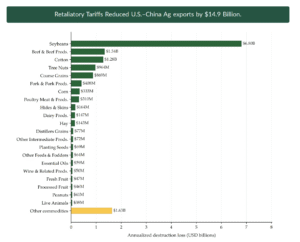
“Researchers Shawn Arita, Sandro Steinbach, and Xiting Zhuang said soybeans alone accounted for roughly half of the losses,” AgDaily reported. “‘Soybeans account for approximately $6.8 billion, or roughly half of the total,’ the study found, while ‘beef and cotton each contribute about $1.3 billion, tree nuts about $964 million, and corn another $333 million.'”
Retaliatory Tariffs Reduced U.S.–China Ag exports by $14.9 Billion. Courtesy of NDSU.
“The report noted that the losses from the latest trade dispute surpassed the damage seen during the 2018-19 U.S.-China trade war under President Donald Trump’s first administration,” AgDaily reported. “The annualized trade losses for the 2018/19 round, measured on the same basis, were approximately $10.6 billion; the 2025/26 figure of $14.9 billion is roughly 41 percent larger.”
“The report also highlighted which states faced the greatest exposure based on production concentration,” AgDaily reported. “Iowa, California, and Illinois each faced roughly $1.2 billion in estimated exposure, followed by Texas, Kansas, Nebraska, Minnesota, Missouri, Indiana, South Dakota, Ohio, Arkansas, and North Dakota.”
Arlan Suderman, Chief Commodities Economist at StoneX, told Farm Policy News that while the tariffs had a negative impact, it’s important for U.S. producers to understand that they’re not the only thing constraining trade to China.
“Soybeans landed at the port in China are roughly a dollar more expensive than Brazilian soybeans before any retaliatory tariff is applied. So, even if the retaliatory tariff is removed, private crushers would still have zero incentive to buy U.S. soybeans. That’s been the case for much of the past year,” he said. “U.S. farmers need to understand that they are not the world’s low cost producer of soybeans, and they likely will not be for the foreseeable future.”
Trade Conflict Could Have Lasting Effects
Agri-Pulse’s Oliver Ward reported that “the effects of the latest trade conflict could also have longer-lasting effects, the authors argue. U.S. ag exports declined by similar amounts in both (trade war) episodes, but they note that sales rebounded swiftly after the announcement of the Phase One deal in 2020.”
“‘The current round has yet to show a comparable rebound,’ they write. China had already pivoted to Brazilian and Argentinian soybean suppliers before the November truce, curtailing U.S. soybean exports across the whole 2025-2026 harvest,” Ward reported. “Further, the lingering 10% tariff rate continues to weigh on U.S. agricultural sales.”
“They also note that, if realized, China’s latest purchase commitments of at least $17 billion in ag buys annually on top of the soybean pledges made in October would also represent a sizeable rebound,” Ward reported.
What Ag Products Could be in New $17 Billion China Deal Remain Unknown
Reuters’ Ella Cao, Daphne Zhang and Lewis Jackson reported that “China and the U.S. have agreed to cut tariffs on agricultural trade as part of a broader trade deal, the Ministry of Commerce said on Wednesday in a statement that left several questions about implementation unanswered.”
“U.S. President Donald Trump and his Chinese counterpart, Xi Jinping, met in Beijing last week, where the White House said China agreed to buy $17 billion worth of U.S. agriculture annually on top of an existing multi-billion-dollar soybean commitment,” Cao, Zhang and Jackson reported. “The commitment would take Chinese imports of U.S. agriculture back towards all-time highs, but fulfilling it would likely require Beijing to drop its tariffs imposed during the trade war.”
“Both parties ‘in principle agreed to include relevant [agricultural] products in the reciprocal tariff reduction framework, while also setting guiding goals to expand two-way trade in agricultural products,'” the Ministry of Commerce said in a statement that largely echoed one made on Saturday,” Cao, Zhang and Jackson reported. “The statement did not say what products could be included or mention the $17 billion commitment.”