TIME’s Rebecca Schneid reported that “the United States experienced its worst spring drought on record last month, with more than 60% of land in the lower 48 states experiencing moderate drought or worse. The drought has sparked alarm among farmers and environmentalists across the country, who warn that food supplies may be impacted and wildfires may blight areas where they are not usually seen.”
“The dry conditions are concentrated in the southeast, where moderate to exceptional drought covered 99.81% of the region at its peak in April, according to the U.S. Drought Monitor,” Schneid reported. “Severe to exceptional drought covered more than 80% of the region, the highest level in April since the monitor began collecting data in 2000.”
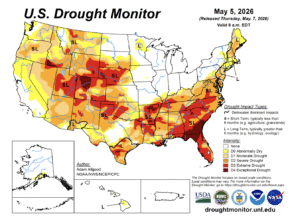
“The drought is threatening to have a severe impact on major agricultural crops, from wheat farmers in Kansas to vegetable farmers in Georgia. The poor conditions and low yields come at a time when farmers are already struggling due to tariffs and the rising cost of fertilizer resulting from the war in Iran,” Schneid reported. “Virginia farmer Billy Bain, 81, told a local CBS News affiliate that this year, his 58th year planting crops, is the worst drought he has ever seen.”
“‘We had to stop planting because it’s so dry,’ Bain said, adding that the costs of his farm have gone up in the wake of the fuel crisis sparked by the Iran war,” Schneid reported. “‘It’s very costly per day, especially when you are looking at diesel fuel prices at $4 for off-road, over $5 on road, so just another cost when you have dry weather.'”
“For wheat farmers across the Great Plains, those late April to early May weeks are critical as winter wheat begins to mature before the summer harvest,” Schneid reported. “Yet, the U.S. Department of Agriculture (USDA) forecast that this year’s wheat acreage will be the lowest since 1919.”
Wheat Acres Being Abandoned in Kansas
RFD-TV’s Marion Kirkpatrick reported that “months of dry weather are forcing some Kansas farmers to abandon hard red winter wheat acres as drought conditions continue to pressure crops across the Southern Plains. Meanwhile, in Oklahoma, winter wheat is also under significant stress, with nearly half of the crop rated poor to very poor amid ongoing moisture shortages and disease concerns.”
“In Kansas, prolonged dry weather is driving some farmers to abandon hard red winter wheat fields, while others are shifting to alternative crops based on local conditions. An economist with Kansas State University says the impact is uneven across the state,” Kirkpatrick reported.
Months of dry weather are forcing some #Kansas farmers to abandon hard red winter #wheat acres as #drought conditions continue to pressure crops across the Southern Plains. Current projections place abandonment at 10-13% statewide.https://t.co/bCCy46dO4O
— FarmPolicy (@FarmPolicy) May 11, 2026
“‘As you drive around the state right now, you see some fields that have been sprayed with the intention of planting spring-seeded, fall-harvested crops into them—corn, sorghum, maybe soybeans, depending on where it’s at. But I’ve seen that, I guess, more so in the central part of the state. In the western part of the state, we vary quite a bit. It’s, I guess, I’d call it spotty,’ Daniel O’Brien said,” according to Kirkpatrick’s reporting.
“Industry estimates suggest abandoned wheat acres in Kansas could rise further if dry conditions persist,” Kirkpatrick reported. “Current projections place abandonment at 10-13% statewide, though final figures will depend heavily on late-season moisture.”
USDA Designates Natural Disaster Areas in Southern Plains Due to Drought
The Oklahoma Farm Report reported that “the United States Department of Agriculture (USDA) has officially issued a Secretarial natural disaster designation for numerous counties across Texas, Kansas, Colorado, Nebraska, and Oklahoma. This fast-track designation is triggered by significant drought conditions recorded by the U.S. Drought Monitor, specifically in areas that have experienced at least eight consecutive weeks of D2 (Severe Drought) or higher-intensity D3 (Extreme) and D4 (Exceptional) drought during the growing season.”
“This designation allows the USDA Farm Service Agency (FSA) to provide emergency credit to agricultural producers through emergency loans,” the Oklahoma Farm Report said. “These funds are designed to assist in the recovery process, covering essential needs such as replacing livestock and equipment, reorganizing farming operations, or refinancing specific debts. The FSA will evaluate loan applications based on the extent of the losses suffered, the producer’s repayment ability, and the available security.”