Hoosier Ag Today’s C.J. Miller reported that “a second case of the flesh-eating New World screwworm has been confirmed in South Texas, intensifying concerns among agricultural officials and prompting Canada to suspend livestock imports from Texas as authorities mount an aggressive response to prevent the parasite from spreading deeper into the United States.”
“On Friday, the Canadian Food Inspection Agency announced temporary restrictions on livestock imports from Texas. Under the order, cattle, horses and other livestock that originated in Texas or were present in the state within 21 days before entering Canada will be denied entry,” Miller reported. “Canadian officials emphasized that the parasite is unlikely to establish itself permanently because of the country’s colder climate but said precautionary measures were necessary during the summer months.”
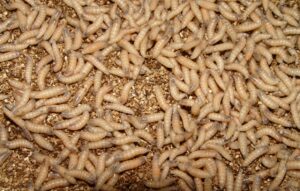
Mature New World screwworm larvae. Courtesy of the USDA APHIS.
“The United States and Canada maintain a substantial cross-border livestock trade network, with animals routinely transported for breeding, feeding and slaughter,” Miller reported. “Canadian authorities imported roughly 550,000 cattle from the United States last year, according to government figures. The Texas outbreak has also prompted Gov. Greg Abbott to issue a disaster declaration covering Zavala and neighboring Uvalde County.”
But USA Today’s Eduardo Cuevas reported that “Andrew Mahaleris, a spokesperson for Abbott, said Canada was overreacting as Texas and USDA are moving quickly to contain and eradicate screwworm in a limited area of South Texas. ‘This pest affects live animals and does not impact inspected Texas beef,’ Mahaleris said in a statement to USA TODAY sent June 6. ‘Canada’s broad restriction on Texas livestock is an overreaction that is more political than science-based.'”
Texas Ranchers Question USDA’s Screwworm Response
Reuters’ Heather Schlitz reported that “the U.S. Department of Agriculture (last) week confirmed two infestations of New World screwworm in Texas — the state’s first cases since the 1970s. However, local residents and ranchers remain split over whether to trust the agency’s response, with some saying it’s too slow or not far-reaching enough.”
“On Friday, about 100 ranchers in mud-splattered boots and cowboy hats packed a small high school cafeteria for a Texas Animal Health Commission briefing on screwworm, peppering officials with questions and venting frustration over what they saw as a slow federal response,” Schlitz reported.
“After the meeting, (rancher John Paul) Schuster lambasted what he saw as the slow pace of sterile fly plant construction, saying a wider infestation could endanger the ranching and hunting industries crucial to the economy for Kinney County’s 3,000 residents,” Schlitz reported. “‘If it’s not controlled in two years and eradicated in five years, my little county will be done,’ Schuster said.”
“Though the USDA has detailed its strategy for containing screwworm, some ranchers have bristled at what they view as a lack of transparency, including the agency’s decision not to disclose exact coordinates where sterile flies are being released,” Schlitz reported. “…Other ranchers dismissed the USDA’s recommendations—including daily inspections and preventive treatments — as impractical for operations that span thousands of acres, face severe labor shortages, and lack skilled cowboys.”
Blame Game Begins
USA Today’s Cuevas reported that “the Trump administration has faced increasing criticism for Elon Musk’s Department of Government Efficiency cuts to a U.S. Agency of International Development program to monitor and prevent the spread of New World screwworm in Central America, according to an agriculture industry trade publication. Texas Agriculture Commissioner Sid Miller told NBC that USDA moved too slowly and relied only on a partial solution that would take years.”
“In response to emailed questions, USDA denied that budget cuts caused screwworm’s entrance into the country,” Cuevas reported. “Agriculture Secretary Brooke Rollins has blamed the previous Biden administration, which left office nearly a year and a half ago, for past immigration and border policies allowing the parasite’s spread. Instead, she said, USDA is investing in sterile fly production and releases.”