The New York Times’ Lydia DePillis reported that “in the first half of the 2026 fiscal year, the Labor Department certified 17 percent more (H-2A Temporary Agricultural Worker) jobs than in the same period the year before.”
“In theory, the program is mutually beneficial. Growers get crucial help during the growing season, and foreign workers make far more than they would at home without having to risk sneaking across the border,” DePillis reported. “…The program’s rapid expansion, however, comes with significant risks. H-2A visas have historically been ridden with fraud, labor trafficking and abuse. According to the Government Accountability Office, of the 2,857 investigations that the Labor Department pursued from 2018 to 2023, 84 percent found violations.”
“The agriculture industry is trying to police itself and reward good behavior, but the efforts depend on the good will of growers and labor contractors, which take up an increasing share of the visas,” DePillis reported. “‘Having workers tied to an employer for their legal status, their wages, working conditions, their ability to return, creates such a power differential that really exacerbates vulnerability to forced labor,’ said Rachel Micah-Jones, executive director of the Centro de los Derechos del Migrante, which advocates on behalf of migrant workers.”
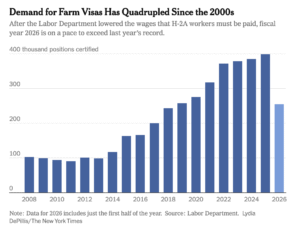
“Since 2013, as farmworkers have aged and immigration has slowed, H-2A holders have quadrupled to become a sixth of the agricultural labor force,” DePillis reported. “The program is poised to grow even faster. As the Trump administration pursues undocumented immigrants, it’s becoming harder to find workers, foreign or native-born. And the White House has restricted many avenues for legal immigration, such as refugee status, H-1B visas for skilled workers and any immigrant visas for people from 75 countries.”
“But farmers pushed back, and the Agriculture Department responded,” DePillis reported. “Last fall, it lowered the wages that guest workers must be paid, substantially decreasing the cost of the program.”
House Ag Chair Seeks to Broaden H-2A Program
Agri-Pulse’s Kim Chipman, Sarah Gonzalez, and Noah Wicks reported last week that “House Agriculture Chairman Glenn “GT” Thompson, R-Pa., is calling to broaden a U.S. temporary agricultural worker program under an early draft of a proposed ag labor bill.”
“The measure defines ‘temporary’ as work contracted for a term of fewer than 350 days, ‘without regard to the approved employer’s underlying need or nature of the job,’ according to the text obtained by Agri-Pulse,” Chipman, Gonzalez and Wicks reported. “That would make it easier for dairies and other businesses to get longer term help despite employing temporary employees.”
“Thompson has said the forthcoming bill would be informed by suggestions made in a final 2024 report by the House Ag Committee’s Agricultural Labor Working Group. The panel’s recommendations include clarifying that H-2A admissions are both seasonal or temporary and that a ‘temporary worker admission is based on a requested length of employment of less than one year without regard to separately evaluating a farmer’s underlying need or the nature of the job,'” Chipman, Gonzalez and Wicks reported. “‘That clarification will ensure that the labor needs of today’s agriculture industry, including producers, ranchers, livestock markets, indoor agriculture, and forestry, are met,’ the report said.”
H-2A Requests Topped 400,000 in 2025
The American Farm Bureau Federation’s Samantha Ayoub reported in January that “the H-2A program continues to grow, with 13,358 more positions certified in fiscal year 2025 (October 2024-September 2025) than fiscal year 2024. This marks the first year in program history that over 400,000 workers were requested, highlighting the continued domestic labor shortages American farmers and ranchers face.”
“Nationwide, 398,258 positions were certified in FY 2025 as eligible for an H-2A worker. These are positions that arise from a proven lack of domestic interest in the seasonal jobs, let alone shortages in employees who work throughout the year,” Ayoub reported. “The H-2A program has grown 185% in the last 10 years. While growth has slowed in the last three years, over 13,300 additional workers were certified in 2025 compared to 2024.”