CNBC’s Spencer Kimball reported that “the Trump administration is examining whether a diesel export ban is a feasible way to address record-high prices for the critical fuel, Treasury Secretary Scott Bessent said Tuesday.”
“‘We’re examining whether it’s feasible in terms of the overall refining capacity and whether a full or partial ban would work,’ Bessent told reporters at a bilateral meeting between President Donald Trump and Ukrainian President Volodymyr Zelenskyy at the United Nations,” Kimball reported. “Trump said a decision would be made ‘fast one way or another’ on whether to impose an export ban. The president said he’s called for a diesel export ban ‘within my people.'”
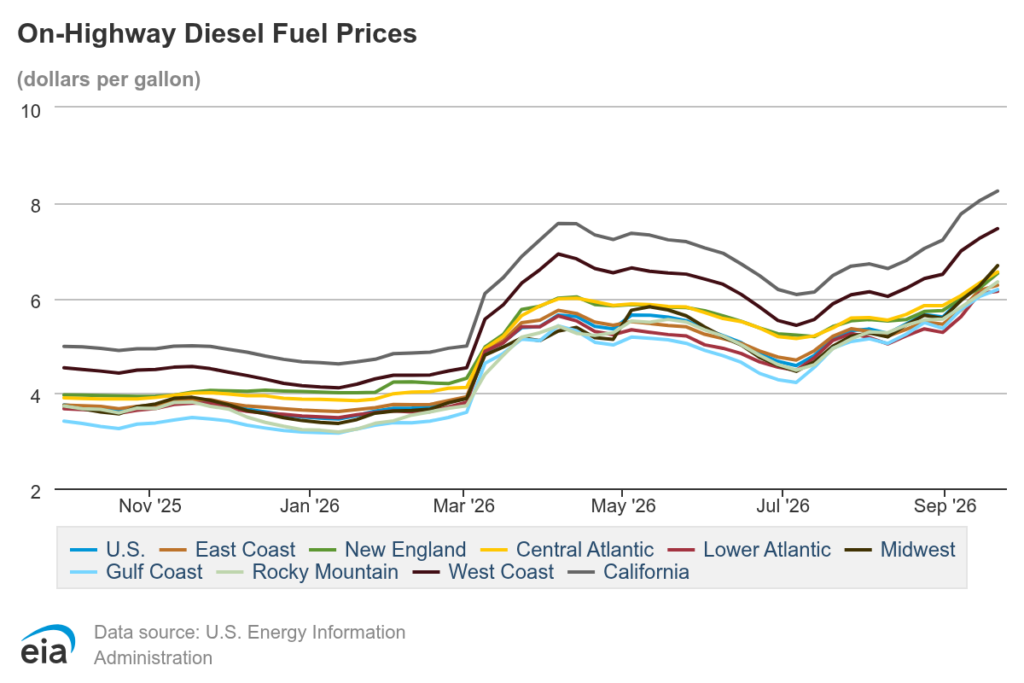
CBS News’ Aimee Picchi reported that “average diesel costs hit a record $6.53 a gallon on Tuesday, up 77% from a year ago, according to AAA data. Diesel is vital across the nation’s agriculture, trucking and construction sectors, with the price surge especially painful for farmers and small businesses.”
“Many of the calls for a diesel export ban are coming from lawmakers in states with agriculture-rich economies,” Picchi reported. “Iowa Republicans Sen. Chuck Grassley and Rep. Ashley Hinson are among those calling for American energy companies to be barred from selling diesel outside of the U.S., arguing that could help lower prices for Americans.”
Politico’s James Bikales and Rachel Shin reported that “Agriculture Secretary Brooke Rollins said Trump called her Monday to discuss diesel prices … which she called ‘a real concern.’ Energy Secretary Chris Wright, Interior Secretary Doug Burgum and other White House officials were working on the issue through the weekend, Rollins said, adding that she expects an announcement ‘very soon on some potential actions.'”
“‘I’ve certainly worked to make sure that the cause and concern of our farmers and ranchers, especially in that area right now, with the cost of diesel and fuel overall, they understand that’s a priority,’ Rollins told POLITICO at a press briefing,” Bikales and Shin reported.
Analysts Say Export Ban Wouldn’t Help Long Term
The Wall Street Journal’s Meridith McGraw, Benoît Morenne and Collin Eaton reported that “analysts caution an export ban could backfire longer term. Domestic refineries would likely opt to process less crude since they will have lost a slew of overseas customers. In that scenario, they would make less gasoline and jet fuel as well, leading to higher prices.“
“‘If an export ban creates a spontaneous glut, it would likely drive prices down—but maybe not for long,’ said Kevin Book, an analyst at energy-research firm ClearView Energy Partners,” according to McGraw, Morenne and Eaton’s reporting. “‘When it comes to this sort of intervention, economics says it’s a bad idea in the long run. But in politics, there is no long run.'”
Reuters’ Arathy Somasekhar and Liz Hampton reported that “major trade groups, including the American Petroleum Institute, oppose a ban on diesel exports.”
“‘Restricting US diesel exports would wreak havoc on fuel markets at home and abroad, destabilize refinery operations and deepen a global refining crisis already putting upward pressure on US prices. Gulf Coast refineries produce more diesel than the region consumes, while geography and infrastructure constraints prevent that surplus from simply being redirected to every US market that needs it,’ the API said in a statement,” according to Somasekhar and Hampton’s reporting. “A ban on diesel exports would push up prices of diesel globally, while pushing down prices in the United States and hurting US refining margins, analysts warned.”
Diesel Prices Likely to Remain High in 2027
The Kansas Reflector’s Tim Carpenter reported that “diesel costs are likely to remain elevated through next year to the detriment of farmers struggling to turn a profit and consumers grappling with food inflation, a Kansas State University (KSU) agricultural economist says.“
“Gregg Ibendahl, farm management specialist with KSU’s Extension Service, said the diesel market was influenced by soaring crude prices, limited refining capacity and supply system interruptions,” Carpenter reported. “Consequences of international conflict may sustain those conditions and hold prices at $6–7 per gallon into 2027 or beyond, he said.”
