Progressive Farmer’s Jerry Hagstrom and Chris Clayton reported that “a bipartisan group of former leaders of America’s major agricultural commodity associations and biofuels organizations, farmer leaders, and former senior USDA officials sent congressional ag leaders a letter on Tuesday warning about the deteriorating state of the farm economy, stating there is a risk of ‘widespread collapse of American agriculture.’”
“The group charged that Trump administration policies ‘have caused tremendous harm to U.S. agriculture’ and are having long-term negative effects on the competitiveness of farmers and agriculture,” Hagstrom and Clayton reported. “‘Farmer bankruptcies have doubled, barely half of all farms will be profitable this year, and the U.S. is running a historic agriculture trade deficit,’ the letter stated.”
“The letter runs counter to the Trump administration’s narrative that agriculture is on the precipice of ‘golden age’ once some trade agreements start to kick in,” Hagstrom and Clayton reported. “The signatories include past presidents and CEOs of the American Soybean Association, National Corn Growers Association, National Pork Producers Council, National Barley Growers Association, National Milk Producers Federation, US Grains Council, and Renewable Fuels Association; past directors of the Illinois and Nebraska Departments of Agriculture; and other farm leaders and senior agricultural policy experts.”
Former US agriculture officials, top Republican senator warn of farm country trouble – https://t.co/1E7sZbWXet
— Reuters Ag News (@ReutersAg) February 4, 2026
Farm Progress’ Joshua Baethge reported that “in the letter, the former officials stated several factors, including increased input costs, trade disruptions, labor shortages, USDA cuts, and the deduction for foreign aid and domestic food programs have all contributed to the dire situation. According to the signers, administration policies have contributed to what the authors have deemed a ‘crisis.'”
Farmer Sentiment Falls in January
At the same time as the letter, Bloomberg’s Michael Hirtzer reported that “US farmer sentiment fell by the most in nearly six years in January as operators who have been relying more on loans turned pessimistic on exports of crops like soybeans.”
“The monthly survey of 400 operators with production value of at least $500,000 found farmers are increasing the amount they are borrowing, with more than half expected to use the Trump administration’s $12 billion aid package to pay down debt,” Hirtzer reported. “The Purdue University-CME Group Ag Economy Barometer plummeted to a reading of 113, with the net drop the biggest since April 2020, during the coronavirus outbreak.”
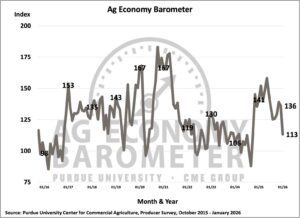
Purdue University’s Michael Langemeier and Joana Colussi reported that “the percentage of producers who expected there to be bad financial times in the next twelve months increased from 47% in December 2025 to 59% in January 2026, while the percentage of producers who thought U.S. agriculture would have widespread bad times during the next five years increased from 24% to 46%.”
“Respondents were also more concerned about exports in January, with 16% expecting exports to decrease in the next five years. When asked about operating loans in the upcoming year, 21% indicated that they expected their operating loan to increase. Although an increase in input costs was the primary reason for this increase, 31% indicated that the increase was due to unpaid operating debt from prior years,” Langemeier and Colussi reported. “Finally, despite the announcement of the Farmer Bridge Assistance Program payments in late December, the percentage of producers who thought the U.S. was heading in the right direction dropped from 75% in December 2025 to 62% in January 2026.”
Letter Suggests Solutions, too
Baethge reported that “as for solutions, the letter lays out a nine-point plan to improve the agriculture economy. Those points include:
-
Immediately exempt all farm inputs from tariffs.
-
Repeal tariffs that are disrupting agriculture export markets.
-
Pass Trade Promotion Authority to enable the administration to pursue and secure meaningful, enforceable, free trade agreements that can be passed by Congress and have the full force and effect of law.
-
Direct the administration to prioritize the negotiation of binding trade agreements with countries that need our agricultural products and that can help offset other market disruptions.
-
Encourage the administration to expeditiously complete the review of the U.S.-Mexico-Canada Agreement, favorably resolve the pending dairy dispute settlement case with Canada, and ensure that the USMCA is extended for the next 16 years.
-
Pass legislation to enable nationwide E15, year-round ethanol, and sustainable aviation fuel to boost domestic markets for U.S. corn and soybeans.
-
Pass a new farm bill.
-
Pass farm labor reform including reform to the H-2A program.
-
Restore funding for land-grant agriculture research, critical USDA staffing, and domestic and international food aid programs.”
“‘We can only hope rural America will survive the current tumult long enough for the administration, Congress and leaders of both parties to recognize the threat and find the temerity to work together on real solutions,’ the letter states,” according to Baethge’s reporting.