RFD-TV’s Marion Kirkpatrick reported that “farmer sentiment weakened in April as producers continue to grapple with rising input costs and ongoing uncertainty about availability, according to the latest Purdue University Ag Economy Barometer.”
“The monthly survey found a noticeable drop in producer confidence, driven largely by concerns over fertilizer, fuel, and other key inputs needed for the 2026 growing season,” Kirkpatrick reported. “Farmers reported growing anxiety about both the price and timely access to these supplies, which economists say is directly influencing planting decisions and financial outlooks.”
“The report shows that while some producers remain cautiously optimistic about long-term conditions, short-term sentiment took a hit. A key factor: volatility in input markets,” Kirkpatrick reported. “Many respondents indicated that sharp swings in fertilizer and diesel prices are making it increasingly difficult to lock in break-even levels or plan ahead with confidence.”
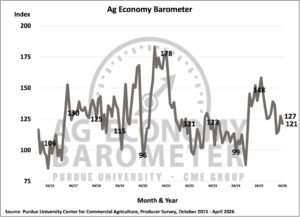
Purdue University’s Morgan French reported that “only 15% of producers indicated that financial conditions improved in April compared to the same period last year. When looking at the year ahead, 28% of respondents cited expectations of worse financial performance, compared with 25% expecting better financial performance. The Farm Capital Investment Index also fell by 9 points to 44, its lowest level since October 2024, indicating a decline in willingness to make large investments.”
“April’s survey also examined the impact of current events on farm income and corn break-even prices in 2026. Approximately two-thirds of respondents expect to reduce their farm’s net income in 2026,” French reported. “Among producers who planted corn in 2025, about half expect corn break-even prices to increase by up to 6% in 2026, 14% expect increases of 6% to 9%, and 37% anticipate increases of 10% or more.”
“‘Producers are still under pressure from high input costs, and this month we observed a slight rise in concerns about fertilizer availability,’ said Michael Langemeier, the barometer’s principal investigator and director of Purdue’s Center for Commercial Agriculture,” according to French’s reporting. “‘Simultaneously, the impact of current events on fertilizer and energy markets increases global uncertainty, adding to the existing difficulties farmers face as they plan for the future.'”
Ag Economists Also More Pessimistic on the Economy in April
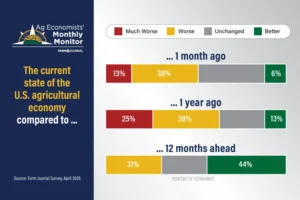
AgWeb’s Margy Eckelkamp reported that “the latest Farm Journal Ag Economists’ Monthly Monitor shows a bit more pessimism from respondents on the current state of the ag economy as well as how the present compares to one year ago.”
“Farm Journal regularly reaches out to a vetted list of 80 ag economists from across the industry. Providing directional insights, 10 of the 16 economists who responded to the April survey believe the ag economy is in a worse state than it was a year ago,” Eckelkamp reported. “Slightly fewer than half expect conditions to be ‘somewhat better’ in 12 months, while one-third still anticipate further decline.”
“‘I just haven’t really changed my level of pessimism regarding this year. This is going to be a tough year. There’s no doubt about it,’ says Michael Langemeier with Purdue University,” according to Eckelkamp’s reporting. “The conflict in Iran weighs heavy on economists’ minds; high fertilizer prices and high energy costs dominate concerns. This overshadows the previous looming concerns of the trade fragility and export deficit. The previously announced government payments are in the rearview mirror.”
“Three-quarters of the economists believe U.S. agriculture is undergoing a permanent structural shift rather than a typical cyclical phase,” Eckelkamp reported. “They cite increased competition from Brazil, changing trade policies and the rapid adoption of artificial intelligence as factors reshaping the industry for the long term.”