



U.S. farmland values continued to rise this year, with the average value of cropland topping $6,000 for the first time, while pastureland reached $2,000 an acre. Overall, farm real estate…
US Winter Wheat Crop Smallest Since 1965, USDA Says
Reuters’ Karl Plume reported that “the U.S. Department of Agriculture on Thursday cut its U.S. winter wheat crop outlook by 2% from a month earlier as a harsh drought in the Plains cut its hard red winter wheat production view to the lowest since 1957″ and total winter wheat production to the lowest since 1965.
“The USDA projected U.S. winter wheat production in the 2026/27 season at 1.030 billion bushels, down from its forecast of 1.048 billion last month and well below last year’s winter crop of 1.402 billion bushels,” Plume reported. “Production of hard red winter wheat, the largest variety grown in the United States, was projected to fall to 497 million bushels, down from an outlook for 515 million last month and well below last year’s 804-million-bushel crop.”
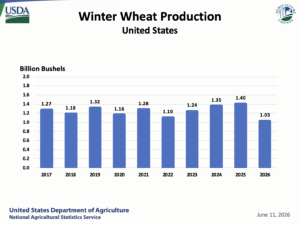
“The drop in production has heaped pressure on U.S. farmers already struggling with rising fuel and fertilizer prices due to the closure of the Strait of Hormuz and trade disruptions caused by U.S. President Donald Trump’s tariff battles,” Plume reported. “The wheat harvest is underway in key wheat states including Kansas, Oklahoma and Texas, although some farmers, particularly in far western areas of the wheat belt, have found little to no grain to gather.”
Winter Wheat in Worst Condition Since 2006
Successful Farming’s Mariah Squire reported earlier this week that “according to the latest USDA data, the nation’s winter wheat crop is in its worst condition since 2006. In its Crop Progress report, released Monday, the department rated 46% of the crop poor or very poor, which is the highest combined percentage since June 2006.”
“It’s yet to be seen whether this season’s crop will surpass 48% poor or very poor, the highest percentage of poor or very poor winter wheat recorded by the USDA since as far back as the fall of 1998. That percentage was reached in June 2006,” Squire reported. “One-fifth of the U.S. winter wheat crop was rated very poor, and about one-fourth was rated poor. Most of the rest was rated fair (29%) or good (21%). Only 4% was rated excellent.”
“For five of the top 18 winter wheat-growing states, at least 57% of their crop was rated poor or very poor, according to the latest data,” Squire reported. “Nebraska’s winter wheat is in the worst shape of all top states. In the latest Crop Progress report, USDA rated 82% of the crop poor or very poor. Fourteen percent was rated fair, and 4% was rated good. None of the crop was rated excellent.”
Drought Forcing Wheat Abandonment Across the Plains
Nebraska Public Media’s Jackie Ourada reported in mid-May that “Nebraska’s winter wheat farmers could be abandoning much of their crop this year due to one of the most devastating droughts on record.”
“The Panhandle Research Extension and Education Center said the University of Nebraska’s High Plains Ag Lab in the Panhandle will likely lose many of its fields,” Ourada reported. “The wheat field site in Scotts Bluff County, which is now in exceptional drought, has already been shut down after the irrigation district there chose to delay beginning irrigation until July. It’s a similar choice made by other irrigation districts that will face very small windows of surface water irrigation this year.”
“The USDA is predicting nearly 36% of wheat fields won’t be harvested this year. It’s not as high as some other states, such as Texas, where wheat abandonment has topped 70%,” Ourada reported. “But total wheat field abandonment nationwide is averaging around 32% for the season, which currently sits as the fourth-highest rate since 1917. The two other highest years were 33.1% in 2023 and 32.3% in 1933, according to the USDA.”
Brownfield Ag News’ Brent Barnett reported this week that “north-central Kansas farmer Shale Porter tells Brownfield ‘We have ourselves abandoned over 200 acres that they adjusted for about 5 bushel an acre,’ Porter said, ‘so we went ahead and terminated those.'”
