



Tyson Foods said on Thursday it will close or sell three of its beef plant and packaging operation sites, further shrinking its beef footprint as a historic U.S. cattle shortage…
Grain & Oilseed Prices Fall on Strait of Hormuz Reopening
Pro Farmer’s Bill Watts reported that “grain and soy complex futures opened modestly lower Sunday night after the U.S. and Iran announced a deal to open the Strait of Hormuz, setting the stage for further talks aimed at ending a four-month old conflict.”
“‘Following intensive talks, we are pleased to announce that the Peace Deal between the United States of America and Islamic Republic of Iran has been REACHED,’ wrote Shehbaz Sharif, Pakistani prime minister and lead mediator in a post on X,” according to Watts’ reporting. “‘Both sides have declared the immediate and permanent termination of military operations on all fronts, including in Lebanon.’ The official signing ceremony will be on Friday in Switzerland, Sharif said.”
“In a social media post, Trump wrote: ‘Deal with the Islamic Republic of Iran is now complete. Congratulations to all! I hereby fully authorize the toll free opening of the Strait of Hormuz, and, simultaneously herewith, authorize the immediate removal of the United States Naval blockade. Ships of the World, start your engines. Let the oil flow!'” Watts reported.
Bloomberg’s Eko Listiyorini and Kanupriya Kapoor reported that “Hormuz is a key conduit for fertilizer and fuels used by farmers, and its shutdown boosted crop prices. The United Nations’ Food and Agriculture Organization had warned in May that a severe global food price crisis could set in within six to 12 months due to the strait’s closure.”
“‘It is modestly bearish for agricultural prices and supportive for crop supply,’ Tobin Gorey, a strategist at the Commonwealth Bank of Australia, said by phone,” Listiyorini and Kapoor reported. “However, it remains unclear whether this is a lasting resolution or another step in the negotiating process so ‘markets will want evidence, not just announcements.'”
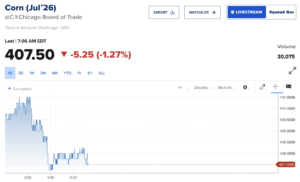
“Some of the war-driven price premium had already begun to fade across crop markets in recent weeks, partly due to ample global stockpiles and a decline in fertilizer costs,” Listiyorini and Kapoor reported. “Monday’s losses extended that drop, with wheat and corn and futures down more than 1% in Chicago. Soybeans notched smaller declines and palm oil fell as much as 0.8% in Kuala Lumpur. The rally in crude oil and fuel prices triggered by the war has boosted demand for biofuels such as ethanol that are made from crops. The peace deal could reverse that trend.”
Fertilizer Markets Won’t Recover Quickly, Experts Say
Progressive Farmer’s Chris Clayton reported that “the potential of a deal between the United States and Iran that would reopen the Strait of Hormuz could ease some of the world’s concerns about fertilizer challenges and food shortages, but it will take time to sort out. The result could leave global fertilizer supplies 20% to 30% short of demand, an executive for Mosaic Co., explained to DTN.”
“Fertilizer companies such as Mosaic Co. have been forced to idle production of phosphate, for instance, because sulfur exports from the Persian Gulf have slowed dramatically,” Clayton reported. “The strait normally handles roughly 50% of all sulfur exports. Additionally, supply constraints have emerged as countries such as China and Egypt have imposed export restrictions on sulfur.”
“Even if shipping traffic resumes normally, fertilizer markets should not expect an immediate recovery, said Ben Pratt, Mosaic’s vice president of public affairs,” Clayton reported. “‘There are a lot of ships parked in the strait right now,’ Pratt said in an interview with DTN. ‘It’ll be months to get normal supply routes back and fully functioning.’“
