



New York farmers can start submitting applications for up to $25,000 in relief from the state as part of a $30 million aid effort aimed at easing the hit to…
Trump Suspends Duties on Moroccan Phosphate Fertilizer
Reuters’ Kanishka Singh reported that “U.S. President Donald Trump has authorized the temporary suspension of certain duties on phosphate fertilizer imported from Morocco, the White House said on Monday, as farmers grapple with shortages due to the Iran war.”
“‘Global supply chains for phosphate fertilizer and fertilizer inputs, including imports of such products into the United States, have been disrupted in recent months by, among other things, conflicts in fertilizer-producing regions as well as trade actions taken by major fertilizer-producing countries,’ Trump said in a proclamation released by the White House,” according to Singh’s reporting. “Currently, U.S. production of phosphate fertilizer is insufficient to support domestic agricultural food production after accounting for exports, Trump said in the proclamation.”
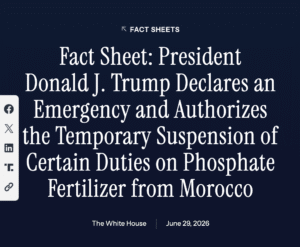
“The Trump administration is working with the private sector to expand domestic fertilizer manufacturing capacity, but those efforts will take time to increase the supply materially, the president said, adding producers in countries like Morocco can supply phosphate fertilizers to the U.S. without disruption at this time,” Singh reported. “Trump declared an emergency in the proclamation that he said authorized the temporary suspension of certain anti-dumping and countervailing duties in connection with imports of phosphate fertilizer from Morocco for eight months or until the emergency is terminated, whichever occurred first.”
AgWeb’s Tyne Morgan reported that “the move follows years of lobbying by agricultural organizations seeking relief from countervailing duties first imposed in 2021. Earlier this year, more than 50 state grower organizations, including the Texas Corn Producers Association, urged the U.S. Department of Commerce and the International Trade Commission (ITC) to revoke the duties as part of the required five-year sunset review.”
“Their argument has centered on rising fertilizer costs,” Morgan reported. “A study by the Texas A&M AgriLife Food and Agricultural Policy Center estimated the countervailing duties increased the price of diammonium phosphate (DAP) fertilizer by nearly 29% during the period the full duty was in effect and added an estimated $6.9 billion in phosphorus fertilizer costs for U.S. producers of corn, wheat, soybeans, rice and other program crops between the 2021 and 2025 growing seasons.”
Farmer Groups Happy with Suspension of Duties
Progressive Farmer’s Chris Clayton reported that “Jed Bower, an Ohio farmer and president of (National Corn Growers Association), thanked Trump ‘for recognizing the economic outlook facing American farmers right now and taking steps to alleviate some of that pressure.’ Bower added the reprieve would help in the sunset review for the duties and the antitrust investigation.”
“The American Soybean Association noted Morocco is the world’s second-largest producer of phosphate, so dropping the duties will increase availability and encourage competitive pricing, which ultimately will improve on-farm margins,” Clayton reported. “‘Suspending import taxes on this critical farm resource will improve fertilizer availability and help reduce input costs at a time when farmers begin to plan for the 2027 crop while tackling increasingly challenging financial decisions,’ said ASA President Scott Metzger, a soybean farmer, also from Ohio. ‘U.S. soybean farmers thank President Trump and his administration for recognizing the challenges facing America’s farmers, identifying targeted solutions to defray farm production costs, and taking meaningful action that will strengthen the agricultural economy.'”
Some Fertilizer Companies Had Asked for Duties to Continue
Bloomberg’s Ilena Peng and John Harney reported that “the lifting of duties, though, will be a blow to domestic producers like Florida-based Mosaic Co., which had asked for the investigation into the Moroccan industry that led to the fees. Mosaic and JR Simplot Co., another US fertilizer company, had both said earlier this year that they would continue to support the duties.”
“The weak US farm economy has challenged demand for fertilizers, and prevented companies from fully passing through higher input costs,” Peng and Harney reported. “Prices for the sulfur and ammonia required to produce phosphate fertilizers have also risen due to the conflict in the Middle East.”
“Mosaic reported a sizable operating loss in the second quarter, and reduced production rates at two US plants due to the elevated input costs,” Peng and Harney reported. “The company’s vice president of public affairs, Benjamin Pratt, said in an interview earlier this month that trade flows for sulfur — and in turn, prices — would take months to return to normal after the reopening of the Strait of Hormuz.”
“The company said in an emailed statement Tuesday that it regrets the suspension of phosphate duties was not accompanied by government intervention to provide relief on sulfur, and will continue to support duties on phosphate imports beyond the eight-month pause,” Peng and Harney reported.
