Farm News Media reported that “USDA’s new 2027 cost of production forecast reveals farmers may not see meaningful relief from elevated production costs anytime soon. The projections show total production costs continuing to rise for most major crops, pushing all commodities to record highs — including corn at $952 per acre, soybeans at $701, sorghum at $477 and wheat at $428.”
“Compared to USDA’s earlier 2026 projections, total production costs were revised higher for every major crop included in the report,” Farm News Media reported. “In a new Market Intel report, American Farm Bureau Federation Economist Faith Parum said 2027 projected production costs are not being driven by fuel and fertilizer, but rather by higher prices for seed, chemicals, repairs, labor, machinery and cash rent expenses.”
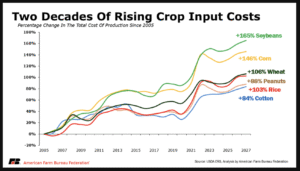
Input costs by crop, from 2005 to 2027, projected. Courtesy of the American Farm Bureau Federation.
“For many crops, projected 2027 costs exceed not only USDA’s previous forecasts but also the highs experienced during the supply chain disruptions and inflationary pressures of the early 2020s,” Farm News Media reported. “Since 2005, total production costs have more than doubled for several major row crops, including soybeans (+165%), corn (+146%), and wheat (+106%).”
“‘While commodity prices often fluctuate from year to year, production expenses have steadily trended higher, leaving farmers increasingly exposed when crop prices decline,’ Parum noted,” according to Farm News Media’s reporting. “‘The record costs projected for 2027 suggest that rising input expenses are no longer a temporary challenge but a persistent reality facing farmers across the country.'”
Production Costs Also Revised Higher for 2026
The Farm Bureau’s Parum wrote that crop input costs for the 2026 season have also been revised higher than USDA’s previous estimate. “Rice had the largest increase, with projected costs rising nearly $75 per acre (5.6%), followed by peanuts at nearly $30 per acre (2.5%) and corn at more than $19 per acre (2.1%),” she wrote.
“Much of the increase in USDA’s updated (2026) cost estimates can be traced to higher fuel and fertilizer expenses,” Parum wrote. “Compared to USDA’s earlier 2026 projections, fertilizer costs were revised 9% to 13% higher across major crops, while fuel, lube and electricity expenses increased 33% to 41%. Fuel costs represented the largest upward revision in the report. Projected fuel, lube and electricity expenses increased 41% for sorghum, 36.8% for peanuts and more than 34% for corn, wheat and rice. Fertilizer costs also moved sharply higher, increasing 11.7% for rice and more than 11% for corn, soybeans and peanuts.”
“However, the recent easing of tensions in the Middle East and the end of the Iran conflict could provide some relief to global energy markets. USDA does project that fuel and fertilizer prices will drop in 2027 as the Strait of Hormuz opens and resumes normal traffic,” Parum wrote. “However, high production expenses in other categories and low commodity prices will likely continue weighing on the economic viability of farms. USDA will revise its forecast in November.”
“Not all cost categories moved higher in 2026. Seed and chemical expenses were revised lower for most crops, partially offsetting increases elsewhere,” Parum wrote. “However, the magnitude of higher fuel and fertilizer costs outweighed those declines, resulting in cost increases for all crops covered in the report.”
While Projected Costs Have Increased, Crop Prices Have Decreased in Recent Weeks
Successful Farming’s Bryan Doherty reported that at the same time that production costs were revised higher for 2026 and 2027, “the last several weeks saw massive selling pressure in the corn, soybean, and wheat markets. After rallying for multiple months, prices peaked in early May and began to slip.”
“This spring, rapid planting progress for corn and soybeans, along with an impending wheat harvest, added to price pressure,” Doherty reported. “This created an environment where traders were quick to exit long positions once prices began to slide. Other technical indicators, such as moving averages and overbought conditions, also initiated new selling or exiting positions, adding to price pressure.”
“December corn futures, after trading above $5, quickly gave up 10% of their value and are currently trading under $4.50. November soybeans peaked at over $12 and are now trading under $11.50. Old-crop values suffered greater losses as the market took the view that there is little reason to ration inventory,” Doherty reported. “For wheat, despite the fact that production is forecast to be the lowest in over 50 years, futures gave up more than 15%. Managed money leaving the market played a big role.”