Below-Breakeven Prices Projected for Major Crops
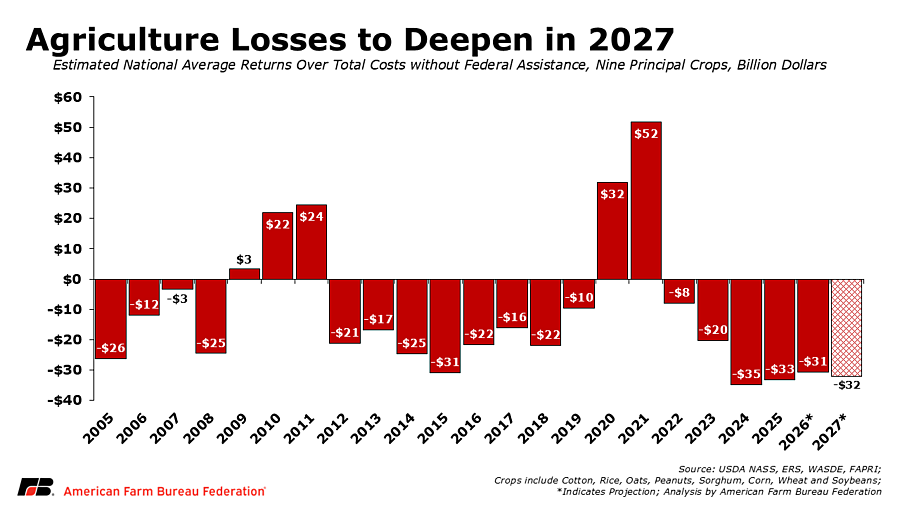
AGDaily reported that, “the updated analysis, published in the latest Farm Bureau Intel, found that most major crops are expected to remain below breakeven on a per-acre basis next year. The Farm Bureau Intel states, ‘Corn losses are projected to increase from $131 per acre in 2026 to $167 per acre in 2027. Soybean losses are projected to increase from $80 per acre to $138 per acre, wheat losses from $114 per acre to $145 per acre and cotton losses from $342 per acre to $406 per acre. Rice, sorghum, oats, barley and peanuts are also projected to remain below breakeven.’” “In total dollar terms, corn accounts for the largest projected loss at $15.8 billion, followed by soybeans at $11.6 billion, wheat at $6.6 billion and cotton at $3.8 billion,” Northern AG Network reported. “Combined, losses across the nine principal crops are projected to reach $41.4 billion in 2027.” “These 2026 and 2027 figures represent projected, not realized, losses,” Northern AG Network reported. “Producers still have time to adjust acreage and input decisions, while weather, yields, market prices and other factors could change the final outcome. The 2027 estimate assumes crop prices remain at 2026 levels, though actual prices will vary in response to changing market conditions.”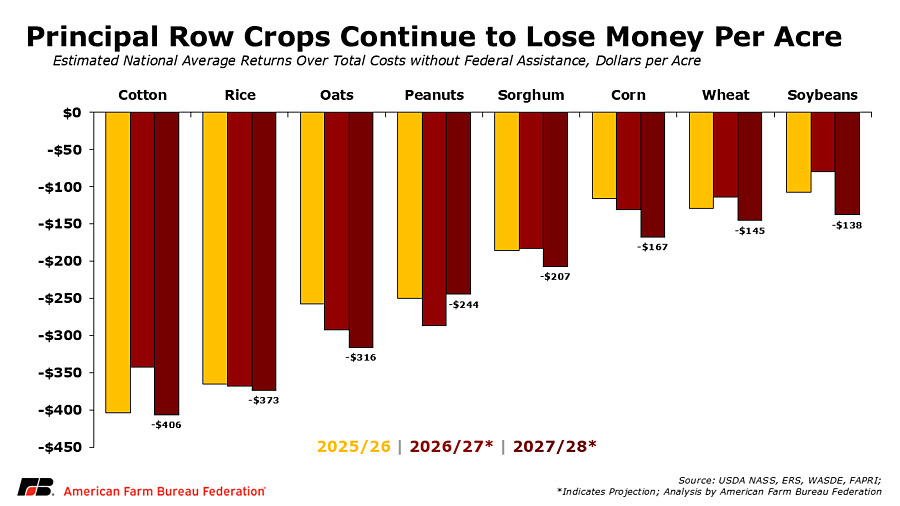
Speciality Crops Struggle with Below-Breakeven Prices, Acreage Reduction
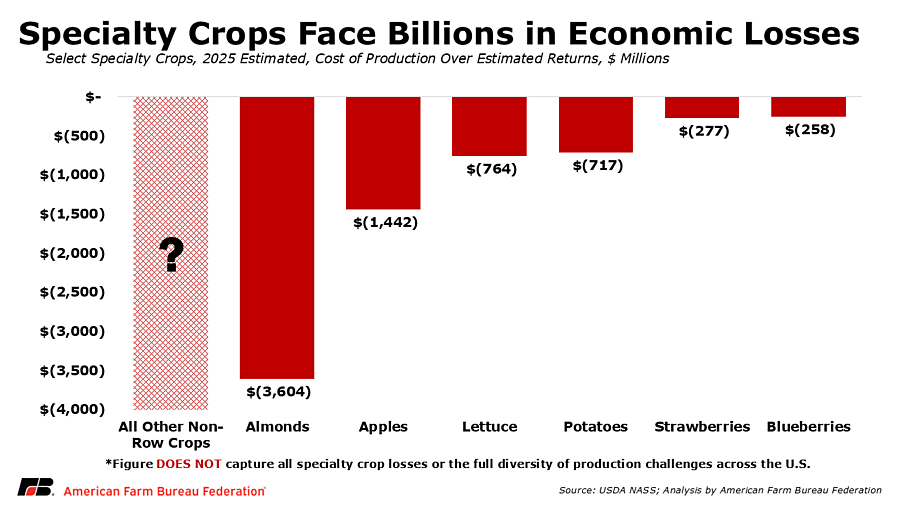
Michigan Farm News’ Mitch Galloway reported that, “specialty crop farmers are experiencing a similar financial strain, facing expected below-breakeven prices and acreage reductions across major fruit, vegetable and tree nut sectors in 2026, even as limited public data make the full scale of losses difficult to measure.” “The Farm Bureau Intel outlines six representative specialty crops — almonds, apples, blueberries, lettuce, potatoes and strawberries — with ‘over $7 billion in estimated 2025 economic losses as labor, input, compliance and capital costs outpaced farm-level returns,’” AGDaily reported. “Available 2026 market data show that conditions for specialty crop producers have not broadly improved. Those six crops represent roughly one-quarter of all specialty crop receipts, suggesting financial pressures could be even broader across the sector.” “The economists said recent economic conditions also show a shrinking domestic specialty crop footprint,” Galloway reported. “Since 2000, U.S. vegetable acreage has declined 41%, while production has fallen 24%, from 37 million metric tons to 28 million in 2024. Fruit acreage has declined 37%, while production has fallen 48%, from 51 million metric tons to 26 million. Tree nut production strengthened during years of stronger markets, peaking at 3.7 million metric tons in 2020, but had fallen to 3.2 million by 2024.”