



U.S. farmland values continued to rise this year, with the average value of cropland topping $6,000 for the first time, while pastureland reached $2,000 an acre. Overall, farm real estate…
USDA Reports Largest-Ever Combined Corn & Soy Planted Acreage
United States farmers planted a record amount of corn and soybeans in the 2026/27 season, the Agriculture Department reported on Wednesday, with combined planted acreage of the two crops reaching 183.5 million acres, more than 3 million acres higher than the previous combined crop record.
The combined acreage record was reflected in Wednesday’s Crop Production and World Agricultural Supply and Demand Estimates reports from USDA, which Progressive Farmer reported “found an additional 1.4 million planted acres for both the corn and soybean crops to increase the corn crop slightly and boost the soybean crop to the largest in U.S. history.”
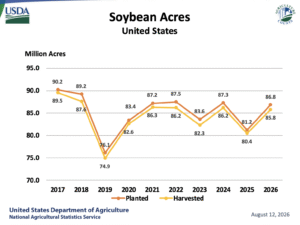
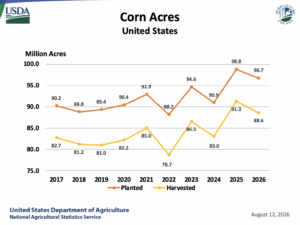
“USDA boosted corn acres by 1.4 million acres (ma) to 96.7 ma and increased production to 16.013 billion bushels (bb) despite dropping the corn yield by 2.3 bushels per acre (bpa),” Progressive Farmer reported. “USDA also increased soybean planted acres by 1.4 million to 86.8 ma to increase production to a projected record of 4.519 bb.”
Farm Futures’ Bruce Blythe reported that “USDA didn’t provide specifics on reasons behind the higher corn and soybean acres. But it’s likely that acreage certification data collected by USDA’s Farm Service and Risk Management agencies in recent weeks showed farmers planted more of both crops than what was forecast in June.”
The Wall Street Journal’s Kirk Maltais reported that “the USDA said it projects the national corn yield for the 2026/27 season at 180.7 bushels an acre. That’s down from 183 bushels an acre projected in July’s report, and is a much larger cut than the one expected by analysts surveyed by The Wall Street Journal, who forecast an average yield of 182.5 bushels an acre.”
“Most-active corn futures on the CBOT jumped after the WASDE’s release, up 2.9% to $4.74 a bushel,” Maltais reported. “The market reacted positively to the yield cut, but the USDA also increased the amount of corn acres expected to be harvested this year to 88.6 million acres, which is why even with the lower yield, the USDA increased its production expectations by 13 million bushels from last month, to 16.013 billion bushels.”
“The USDA pegged soybean production at 4.52 billion bushels, up 44 million bushels from last month’s estimate,” Maltais reported. “Projected yield for this year was reduced to 52.7 bushels an acre from 53 bushels an acre forecast last month.”
USDA Confirms Smallest Wheat Production Since 1970
The Wall Street Journal’s Maltais reported that “the USDA also confirmed that total U.S. wheat production remains at its lowest in more than 50 years, forecasting an output of 1.53 billion bushels this year on a yield of 47.8 bushels an acre. That’s down 5 million bushels from the agency’s projection last month, and remains the smallest wheat crop grown in the U.S. since 1970.”
August Continues to be the Month of USDA Data Surprises
Agri-Pulse’s Kim Chipman reported that “USDA caught the market by surprise for the second straight year on Wednesday by boosting its outlook for combined corn and soybean acres by 2.8 million, triggering concern that more revisions could be ahead and weigh on prices amid an already tough farm economy.”
“Kevin Van Trump, president and founder of Farm Direction and the Van Trump Report, said the increased corn acres make him ‘a bit nervous,’ given that USDA raised acreage more than once last year,” Chipman reported. “‘Demand still looks bullish, but the acreage increase is a supply-side risk that cannot be ignored,’ Van Trump said.”
“‘August continues to be the month of surprises, and U.S. harvested acres pull the upset for a second year,’ said Karen Braun, chief market analyst at Zaner Ag Hedge,” according to Chipman’s reporting. ‘At this point, we need to ask why the June survey is suddenly a poor indicator of acres.'”
“Some ag watchers on social media questioned how such large plantings took place at a time when fertilizer prices were climbing higher due to global shipment constraints amid the U.S. and Israeli war with Iran,” Chipman reported.
