Reuters’ Karl Plume and P.J. Huffstutter reported that “the U.S. Department of Agriculture is launching a pilot project that will rely more heavily on technology as part of a broader effort to improve its closely watched U.S. crop acreage and yield estimates, Secretary Brooke Rollins said on Tuesday, as the agency faces mounting criticism from farmers and traders over the reliability of government agricultural data.“
“Rollins discussed USDA’s data modernization plan at the Farm Progress Show in Boone, Iowa, following a month-long series of listening sessions with farmers and agricultural groups,” Plume and Huffstutter reported. “‘We will conduct a pilot to evaluate the use of improved satellite imagery, working with NASA and other federal government agencies across the country to figure out how we can make this reporting more accurate,’ Rollins said during the farm conference.”
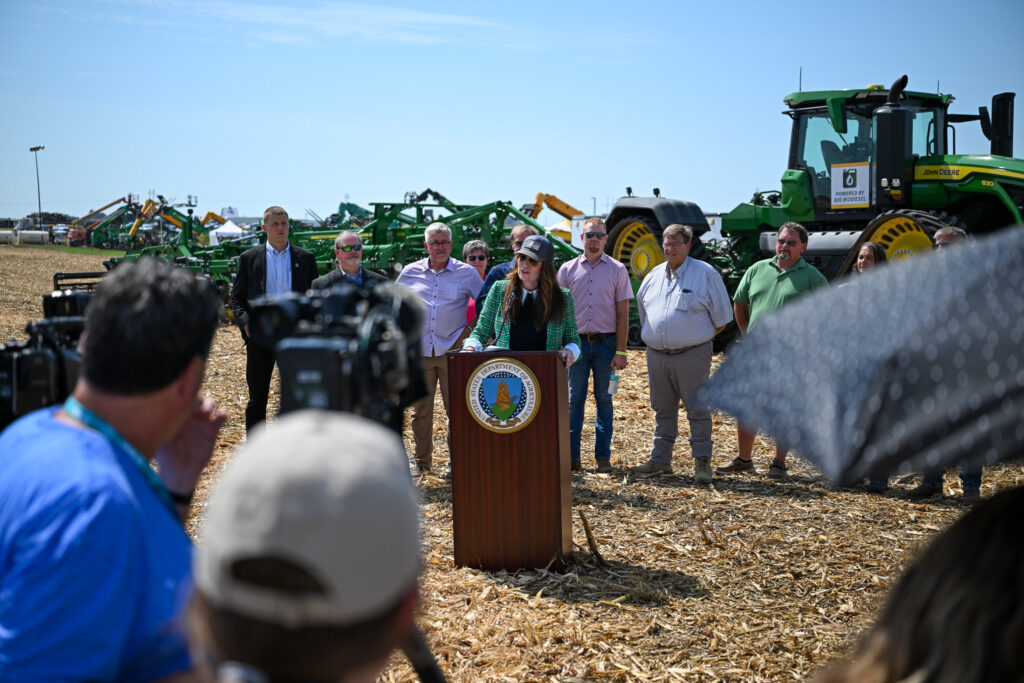
“Under the plan, the project will use geospatial tools and crop models alongside farmer polls to estimate crop acreage and yields. The department also said it would explore the use of artificial intelligence and machine learning,” Plume and Huffstutter reported. “The announcement follows complaints about the reliability of department data from farmers, grain traders and economists after deep staff cuts and unprecedented increases between initial and final estimates of how many acres of corn U.S. farmers planted and harvested in 2025.”
“The data collection changes are intended to reduce the amount of information USDA repeatedly asks farmers to provide while improving the timeliness and accuracy of its statistics,” Plume and Huffstutter reported. “USDA said it would also provide farmers with more information about its methodologies, survey response rates and limitations in its data.”
Modernization Plan Has Four Pillars
AgWeb’s Clare Otto reported that “according to the USDA, the Data Modernization Plan rests on four pillars: Modernize the Data Reporting Experience, Enhance Acreage and Yield Estimation, Integrate Data and Technology Platforms, and Expand Trust and Transparency with Producers.”
“First, USDA will modernize the data reporting experience by expanding use of administrative data, improving mobile access to surveys, exploring options for prefilled information, and strengthening coordination across the department to reduce duplicative requests,” Otto reported. “Second, USDA will enhance acreage and yield estimation by piloting improved satellite imagery, geospatial tools, and crop models combined with producer-reported information. USDA said it will also evaluate optional field inputs to strengthen and ‘ground truth’ yield estimates, while continuing yield research with partners and land-grant universities.“
“Third, the department will integrate data and technology platforms by modernizing technology infrastructure, expanding secure data-sharing capabilities, and evaluating responsible uses of artificial intelligence and machine learning,” Otto reported. “USDA said better-integrated systems would improve efficiency, reduce duplication, and support more timely, useful reporting.”
“Fourth, USDA said it will expand trust and transparency with producers by protecting privacy, explaining why information is requested and how it is used, and offering more opportunities for feedback. The department also said it will improve communications around reports, methodologies, response rates, and data limitations,” Otto reported. “USDA leadership said implementation begins immediately.”
Report Accuracy Remains Biggest Challenge
Progressive Farmer’s Chris Clayton reported that “farmers often say USDA reports are wrong when they disagree with USDA’s numbers. Responding to a question from DTN, Rollins and (Scott Hutchins, USDA’s undersecretary for Research, Education and Economics) said determining whether a new system is going to be more accurate is one of the challenges.“
“‘It’s not an easy question to answer because there’s a couple ways to look at it,’ Hutchins said,” according to Clayton’s reporting. “‘One is over time, how have we varied from what we predicted at a particular point throughout the year to what actually has happened? Because we do all, at the end of the day, know what the destination is and what the actual is — just way after kind of the market need and so forth. So, we have an opportunity to measure how we’ve done that.'”
“Hutchins said USDA is looking to implement an ‘annual scorecard’ that would detail where USDA began and how the forecasts compared with the information that the department had at the time,” Clayton reported.
