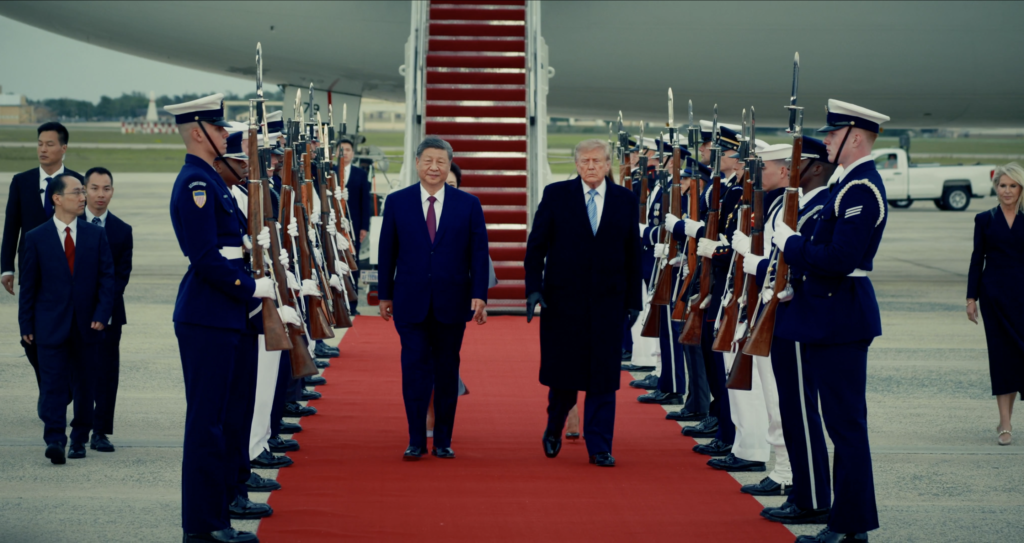
The Associated Press’ Michelle L. Price and Didi Tang reported that “Chinese President Xi Jinping arrived in Washington on Wednesday, where he was met with a rare planeside greeting from President Donald Trump after their top officials agreed to extend a trade truce until January.”
“Trump’s Treasury Secretary Scott Bessent announced the extension of the truce — under which the countries agreed to scale back tariffs and refrain from imposing new trade restrictions — during a Fox News Channel interview as Trump welcomed Xi at Joint Base Andrews just outside Washington,” Price and Tang reported. “‘I don’t know whether a bigger deal can be done. I don’t know whether we will just roll the current deal,’ Bessent said in the interview, noting the extension to Jan. 10 could give the leaders more time to talk about the issues at upcoming international summits in China in November and Florida in December.”
Bloomberg’s Yash Roy reported that “the one-year truce between Beijing and Washington — unveiled at a summit between Trump and Xi in Busan, South Korea (in October 2025) — saw the suspension of some tariffs, rare earth curbs and hefty fees for Chinese-built and -owned vessels calling at US ports.”
“‘There’s some deliverables that have not been perfect on the Chinese side,’ Bessent said, without providing details,” according to Roy’s reporting. “While Beijing has been ‘very fulsome’ with regard to buying US soybeans this year, China is ‘a little behind schedule’ on other agricultural commitments. ‘We are encouraging them to pick those up.'”
US Farmers Seek More Stable China Ag Trade
Reuters’ Karl Plume reported that “soybeans, sorghum and other US farm goods are expected to be high on the agenda at this week’s summit between US President Donald Trump and Chinese President Xi Jinping, joining rare earths trade and artificial intelligence as a focus of contention.“
“US farmers, a key Trump constituency, want China to buy more soybeans and other US agricultural products such as grains and meat, and to ease its retaliatory tariffs on American farm goods,” Plume reported.
Agri-Pulse’s Kim Chipman and Olivia M. Bridges reported that “farmers want to see from the summit ‘something measurable, something that has teeth in it, so we have the confidence in knowing what our potential sales are to China,’ Iowa Corn Growers Association President Steve Kuiper tells Agri-Pulse.”
“‘I am looking mainly for a continuation of the building and the improvement of relations between the two biggest economies in the world, and China as a big trading partner for U.S. ag and U.S. soy,’ Jim Sutter, chief executive officer of the U.S. Soybean Export Council, said in an interview with Agri-Pulse,” Chipman and Bridges reported. “… ‘Soybean farmers ask that you build on the momentum and success of previous meetings with President Xi by ensuring China fulfills its annual purchase commitments, seeking the elimination of tariffs and trade barriers that put U.S. soybeans at a competitive disadvantage to Brazil, and prioritizing a long-term agreement that supports consistency and predictability for U.S. soybean farmers,’ American Soybean Association President Scott Metzger wrote last week in a letter to Trump.”
But Plume reported that “a win for US agriculture looks unlikely, analysts said, with the two sides expected to recommit to previous crop purchase targets without inking any new deals. China has been able to meet its import needs in large part with shipments from other suppliers such as Brazil, while demand from elsewhere for US crops has remained resilient despite the Chinese trade hurdles.”
China May Not be Reliable Long-Term Ag Trading Partner, Former Ag Official Warns
AgWeb’s Tyne Morgan and Michelle Rook reported that “former U.S. Trade Representative Bob Lighthizer addressed at the Iowa Economic Summit in July, and he told farmers not to expect China to be a reliable buyer over the long haul, even as he predicted Beijing would meet its near-term obligations.“
“‘I think that China will live up to it in the short term,’ Lighthizer said,” according to Morgan and Rook’s reporting. “‘If you’re depending long term on China as a key part of your export market, there’s a lot of risk. Just an enormous amount of risk. That’s geopolitical risk and economic risk, and their own domestic policy is contrary to being dependent on these kinds of imports.'”
“That warning adds context to this week’s summit: even a strong showing on soybean purchases may say more about short-term political maneuvering than a durable shift in China’s role as a buyer of U.S. agricultural goods,” Morgan and Rook reported.
