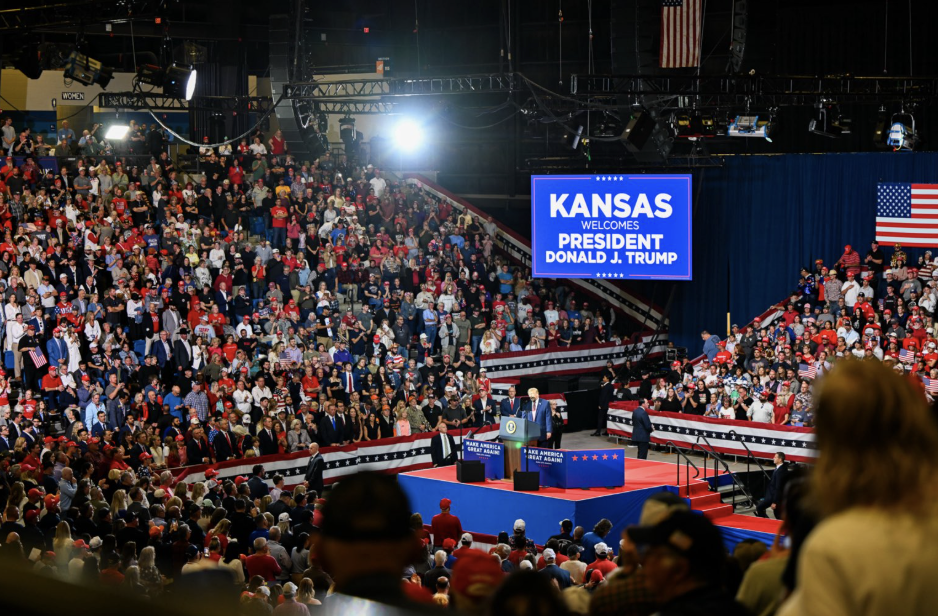
Reuters’ Bo Erickson and Kanishka Singh reported that “President Donald Trump said on Monday the US Department of Agriculture will launch what he called a new ‘harvest fuel relief program’ that will provide farmers with $8 billion in support to offset diesel costs during the harvest season.”
“‘Tonight, I’m also pleased to announce that the Department of Agriculture will be launching a new harvest fuel relief program, providing our farmers with $8 billion in support to offset diesel costs during this harvest season,’ Trump said in a midterm election campaign speech in Kansas,” Erickson and Singh reported. “The announcement was the latest in a series of financial promises and pledges that the Republican leader has made to voters heading into the November midterm elections, where control of Congress is at stake.”
Bloomberg’s Ben Westcott reported that the program “comes as the American harvest is reaching its peak, with more than 64% of the soybean crop already taken in, according to USDA data for the week ending Oct. 18. Almost half of the corn crop has also been harvested.”
“Diesel prices have surged globally as the US-Iran conflict constrains fuel exports through the Strait of Hormuz,” Westcott reported. “Retail prices in the US hit a record at $6.50 a gallon in September, creating headaches for the US president ahead of midterm elections. The Trump administration has sought to ease the impact on growers — traditionally loyal Trump followers — ahead of the vote, including an effort earlier this month to ease limits restricting the use of a tax-exempt variety of diesel.”
Details of the Harvest Fuel Relief Program
Agri-Pulse’s Noah Wicks reported that “through the Harvest Fuel Relief Program, USDA plans to pay producers for some of the losses they are expected to see during the 2026 crop year based on a formula that considers reported Farm Service Agency planted acres, Economic Research Service cost of production estimates, and World Agricultural Supply and Demand Estimates yields and prices, according to a press release. The program will be similar to the agency’s Farmer Bridge Assistance program, which used $12 billion in CCC funding to help bolster farmers’ incomes to help them deal with a challenging farm economy.”
“There was no information provided on how the formula would be calculated for specific crops,” Wicks reported. “USDA noted producers of non-Title I commodities, including specialty crop growers and fishermen, are encouraged to provide data related to increased fuel costs to HarvestFuel@usda.gov for USDA’s consideration when determining payment rates.”
Newsweek’s Anna Commander reported that “the program funds are authorized under the Commodity Credit Corporation (CCC) Charter Act and will be administered through the FSA, the release says. The USDA notes that commodity-specific payment rates for Title-I commodities will be released next month.”
“Crop insurance linkage will not be required for the program, but producers are encouraged ‘to take advantage of the enhanced risk management tools included in the Working Families Tax Cuts Act to best protect against price risk and volatility in the future,’ the release says,” according to Commander’s reporting.
Program is Latest in Series of Moves to Address Diesel Prices
The Hill’s Mallory Wilson reported that “Trump has also tried other initiatives to lower high diesel costs. Earlier this month, he announced steps to increase the availability of red-dyed diesel. The diesel has red dye added to it to signal that it is tax exempt. It’s typically used in farm and construction equipment.”
“While some Republicans have called for a pause to diesel exports, Trump said earlier this month that he would not authorize an export ban on diesel,” Wilson reported.
Axios Ben Geman reported that “late Friday, Trump waived new sanctions against Russia and tariffs on top buyers of Russian energy that would have taken effect under the bipartisan Graham Act he signed last month. That came just days after the administration waived certain sanctions as part of a deal aimed at enabling higher exports of Russian diesel after high prices have become a political millstone for Republicans.”
