Progressive Farmer’s Chris Clayton reported Tuesday that USDA’s recently announced Harvest Fuel Relief Program could “push US government payments to farmers in 2026 to $55.4 billion, based on USDA’s earlier net farm income forecast with $8 billion added to it. The highest previous aid year was $45.6 billion in 2020, driven by trade aid and pandemic payments.”
The $55.4 billion number presumes that the new diesel aid payments go out to farmers by the end of the calendar year, as USDA has so far offered few details on the timeline for what farmers can expect with the program. $55.4 billion in government payments to farmers would be only $10 billion less than combined government payments in 2022, 2023, 2024 and 2025. Additionally, $55.4 billion in government payments would make up just under one-third of USDA’s total 2026 net farm income forecast.
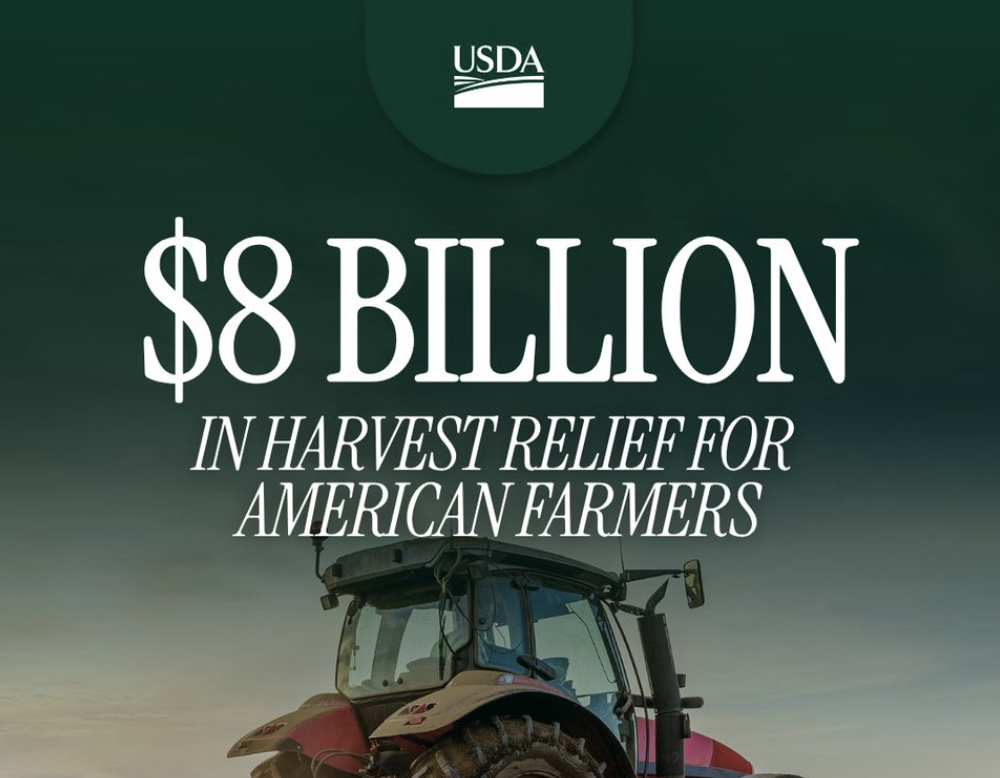
The Wall Street Journal’s Patrick Thomas reported in late June that “government funding has played a bigger role supporting farm incomes over the past decade, with trade war-related payouts during Trump’s first and second terms; rescue funding through the Covid-19 pandemic; and checks to help farmers deal with low crop prices. During this year’s conflict in the Middle East, farmers have had to shell out more cash for fuel to run equipment and fertilizer for planting.”
“Trade groups representing farmers have pushed for more aid, saying it is vital to keep American agriculture afloat,” Thomas reported. “But some economists and industry analysts are raising concerns about the stepped-up government payments, saying it isn’t clear how much is required to maintain U.S. agricultural production.”
Several Farm Groups Critical of More Aid
Newsweek’s Hollie Silverman and Anna Commander reported that “Aaron Lehman, president of the Iowa Farmers Union, described the (diesel) aid as a ‘Band-Aid response’ that would not address what he said were the policy choices driving farmers’ financial problems, according to the Iowa Capital Dispatch.”
“‘Farmers never should have been put in this position,’ he said,” according to Silverman and Commander’s reporting. ‘A Band-Aid response now, two weeks before the election, doesn’t fix the problem.'”
Progressive Farmer’s Clayton reported that “Gbenga Ajilore, chief economist at the Center on Budget and Policy Priorities and former rural development adviser at USDA, said the president’s aid announcement to farmers ahead of the midterm elections follows a pattern in which the president’s policies harm farmers, then he spends taxpayer funds to offset the damage caused. Ajilore pointed to the $28 billion in aid under the Market Facilitation Program (MFP) because of the 2018-19 trade war with China.”
“Farm Action noted the $12 billion Farmer Bridge Assistance (FBA) payments last spring, followed by $13.8 billion in ARC/PLC payments going out to farmers this month,” Clayton reported. “‘Another multibillion-dollar bailout is further evidence of an agricultural economy in crisis,’ Farm Action stated. ‘Instead of addressing the policies and corporate power driving up costs and squeezing farm incomes, the administration continues to rely on taxpayer dollars to keep farmers afloat.'”
Aid Will be Distributed in Late November or Early December at the Earliest
Politico’s Meredith Lee Hill and Grace Yarrow reported that “farmers won’t know how much money to expect for several more weeks. Even then, if approved, they won’t receive the (diesel aid) payments until late November or early December at the earliest, according to three people close to the plans, granted anonymity to share details.”
“With two weeks to go before the election, the new aid may also arrive too late to convince some voters,” Lee Hill and Yarrow reported. “But top Republicans are banking on the announcement to stem GOP bleeding in farm states — especially in the Midwest, where (Kansas Senator Roger Marshall), GOP Senate nominee Ashley Hinson in Iowa and GOP Senate nominee Mike Rogers in Michigan have been struggling in their election campaigns. In some cases, they’ve broken with Trump publicly on high prices and the war.”
