AgWeb’s Tyne Morgan and Chip Flory reported that “USDA’s National Agricultural Statistics Service (NASS) announced it found a processing error affecting September 2026 corn plant populations, ear counts, yields and production for Kansas and Nebraska. The error also affected September averages for plant populations and ear counts across 10 states, along with U.S. corn yield and production forecasts. However, NASS didn’t say exactly what the error was or why.”
“NASS says it has corrected the affected September data in its Crop Production reports and Quick Stats database. NASS corrected the Nebraska corn yield in September to 182 bu. per acre, up 5 bu. per acre from the original report,” Morgan and Flory reported. “However, the agency emphasized that its October forecasts, released Oct. 9, were reviewed and validated and have not changed.”
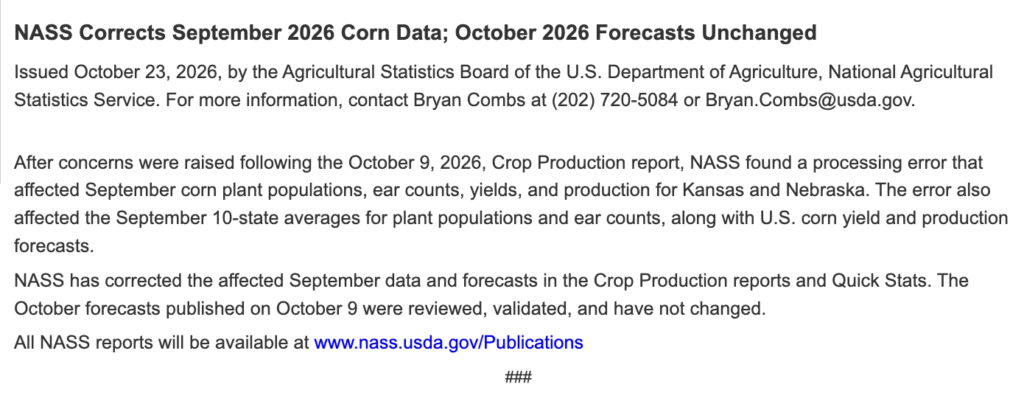
Reuters’ Tom Polansek and Julie Ingwersen reported that “on Friday, the USDA revised its September yield estimate in Nebraska, the third biggest US corn-producing state, to 182 bushels per acre from its original September estimate of 177 bushels, a nearly 3% increase. For Kansas, the agency reduced its September yield estimate by about 2% to 118 bushels per acre, from its original figure of 121 bushels.”
“The USDA on Friday revised its national September yield estimate to 178.8 bushels per acre from the original September estimate of 178.5 bushels per acre,” Polansek and Ingwersen reported. “October crop forecasts were reviewed, validated and have not changed, according to the agency.”
Correction Renews Concerns Over USDA Data Accuracy
AgroLatam’s Marcus Ellington reported that “the revisions have renewed debate over the influence of USDA crop reports on corn futures, farm profitability and grain marketing strategies.”
“For U.S. farmers, the controversy extends beyond statistical accuracy. USDA forecasts influence commodity prices, crop insurance decisions, storage strategies and financial planning across the agricultural supply chain,” Ellington reported. “Questions about data reliability have also emerged following federal workforce reductions that raised concerns about the agency’s technical capacity. As producers navigate tight margins and rising production expenses, transparent and dependable crop estimates remain critical to market confidence and agricultural competitiveness.”
Hoosier Ag Today’s C.J. Miller reported that “National Corn Growers Association (NCGA) leadership is calling out the federal government after USDA admitted late Friday to a major data processing error in its September crop reporting—a mistake corn industry leaders say severely damaged grain markets at the worst possible time for Midwest producers.”
“‘Recent reports by NASS have cost corn growers BILLIONS of dollars in market value, at a time when profit margins were already marginal, at best, and the cost for fuel and other inputs are at all-time highs,’ (NCGA President Matt) Frostic stated,” according to Miller’s reporting. “‘Corn prices dropped in conjunction with the release of recent reports and have only continued to drop. An error of this magnitude is unacceptable, and only further erodes farmer confidence in the agency’s ability to produce statistically sound and accurate reports.'”
Ag Policy and Markets Daily’s Jim Wiesemeyer wrote that “the correction resolves an important Nebraska data inconsistency and substantially reduces the apparent monthly yield jump. It leaves October’s larger national crop forecast standing — and leaves NASS with the task of explaining how an error that affected market-sensitive forecasts passed through its publication controls. And why did it take so long for NASS to issue a correction?”
