Reuters’ Tom Polansek reported that “New World screwworm, a parasitic fly that eats warm-blooded animals alive, has infested a dog in Arizona, widening cases to a third US state, the US Department of Agriculture said on Wednesday.”
“The first detection in Arizona was in Cochise County, which borders Mexico, according to the USDA,” Polansek reported. “The dog had a wound on its back that was infested with maggots, consistent with screwworm, and scientific testing verified the infestation, the Arizona Department of Agriculture said. The dog was receiving veterinary care, it added.”
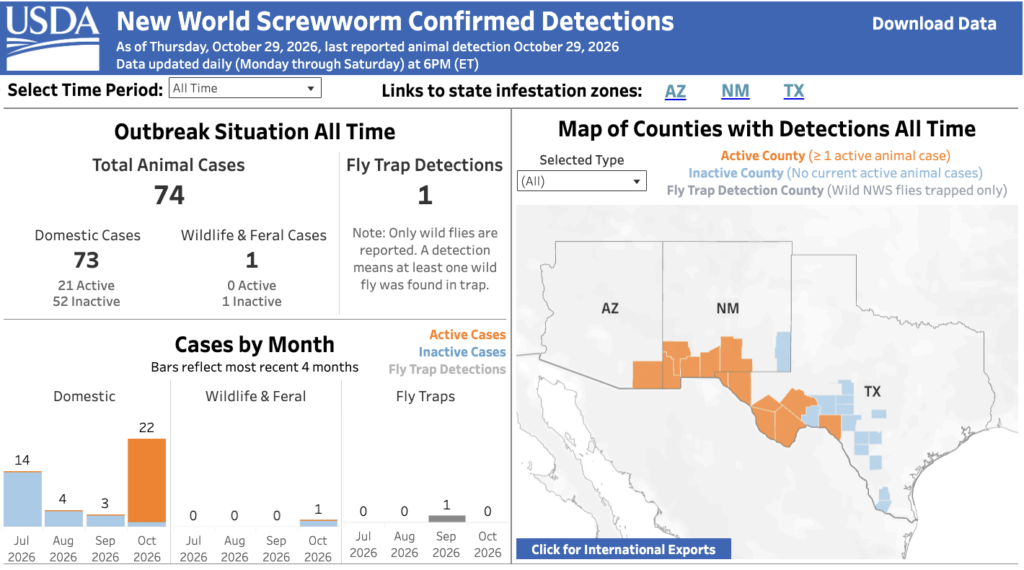
Bloomberg’s Ilena Peng reported that “the spread of the parasitic fly has increased this month. There have been a total of (74) cases of screwworm in the US since the outbreak began, according to the USDA. Eighteen are still active, with 10 located in New Mexico.”
“That makes October the second-busiest month for screwworm cases since the pest was first detected in the US in June,” Peng reported. “Most of those early instances were limited to Texas, and government authorities and ranchers quickly banded together to quarantine affected areas. The fly doesn’t travel far on its own, so its spread tends to be facilitated by the movement of animals.”
Forbes’ Mary Whitfill Roeloffs reported that “the Arizona case comes two months after the Department of Agriculture resumed livestock imports from Mexico—which were halted to try to contain screwworm spread—at three ports of entry in Arizona and New Mexico. Experts have raised concerns a wide screwworm outbreak could severely impact already-suffering cattle numbers and put even more of a strain on ranchers as they spend money on treatment and prevention which could, in turn, increase the price of beef.”
Peng reported that “ranching industry group R-CALF USA is ‘deeply concerned that the USDA prematurely reopened the border before having all its New World screwworm mitigations operational,’ said Bill Bullard, the group’s chief executive officer.”
Texas Sterile Fly Facility Remains on Track for Spring 2027 Opening
Construction Briefing’s Neil Gerrard reported that “Contractor Mortenson and the US Army Corps of Engineers (USACE) are still on course with the rapid construction of a $610 million facility that aims to keep flesh-eating parasites off US soil.”
“Mortenson is building the Department of Agriculture’s Domestic New World Screwworm Sterile Insect Production Facility at Moore Airbase in Edinburg, Texas,” Gerrard reported. “In an update issued this week, USACE said the facility remains ‘on schedule to support the accelerated timeline to reach initial operating capability in April 2027.‘”
Nogales, Arizona Border Port Scheduled to Open in November
Texas Agriculture Daily’s Julie Tomascik reported that “the Columbus, New Mexico, port of entry reopened Oct. 26. It’s the third border crossing to resume cattle imports following months of restrictions due to the spread of NWS in Mexico.”
“The next port scheduled to reopen to cattle imports is Nogales, Arizona, on Nov. 30, pending favorable animal health conditions and completion of required inspection arrangements,” Tomascik reported. “USDA previously reopened the Douglas, Arizona, port on Aug. 24 and the Santa Teresa, New Mexico, port on Sept. 24.”
