The Maritime Executive reported that “the United States faces a squeeze on grain transportation over the next decade because its inland barge fleet is retiring vessels faster than it builds new ones, according to CoBank, a cooperative bank that serves rural industries.”
“In a report released this week, CoBank projects that the U.S. inland barge fleet will shrink by about 17 percent by 2035. The fleet is aging fast, and high construction costs are discouraging owners from replacing old barges, the firm says,” according to Maritime Executive. “Combined with recurring low water on the Mississippi River, the bank says, that points to a transportation bottleneck for grain exports and tighter margins for farmers. CoBank’s analysts say the inland waterway system is entering a period of ‘structural tightening,’ with significant consequences for grain shipping and the wider farm economy.”
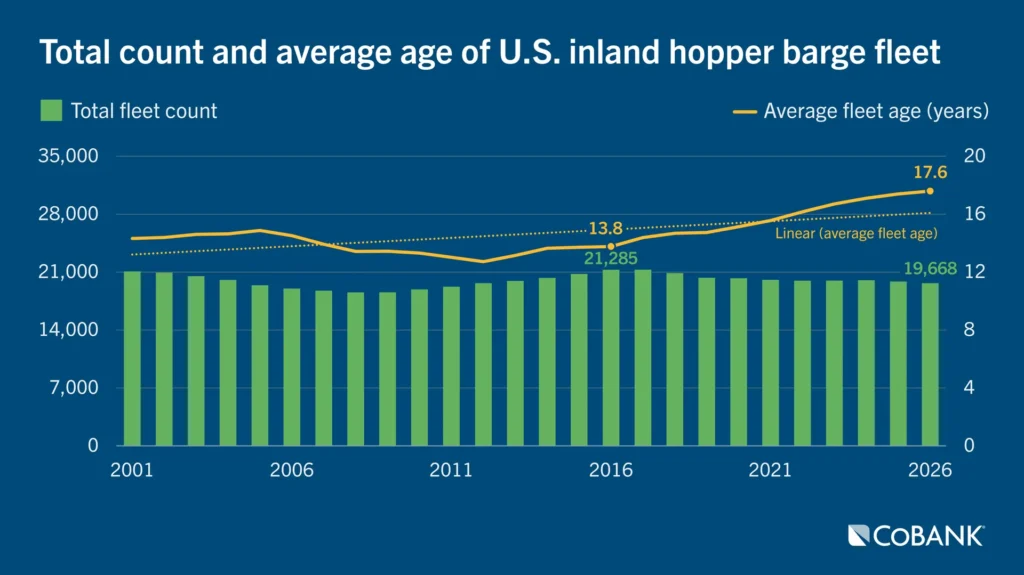
AgWeb’s Margy Eckelkamp reported that “the inland fleet stood at 19,668 barges in 2026, with an average age of 17.6 years. The industry builds about 410 hopper barges a year and retires 500 to 1,000. The average inland barge is approaching 17.6 years old, up from 13.8 years in 2016, according to Current Data LLC figures cited by CoBank. Typical useful life runs 25 to 30 years. Over the past 10 years the fleet has shrunk by 1,617 barges, or 7.6%.”
“The gap between builds and retirements drives the forecast. At about 410 new hopper barges a year against 500 to 1,000 retirements, CoBank projects the fleet at 16,240 barges (about 3,400 fewer barges) by 2035, down 17.4% from today,” Eckelkamp reported. “Replating helps at the margin. Roughly 100 to 200 barges a year get replated out of a fleet of about 19,000, and the work can extend a barge’s life by 12 to 15 years. But the CoBank analysts point out it does not offset the aging of the fleet.”
World Grain’s Arvin Donley reported that “CoBank said escalating costs remain a major obstacle to fleet renewal.”
“Steel is the single largest input in barge construction, and prices remain elevated due to strong domestic demand and long-standing Section 232 steel tariffs,” Donley reported. “US steel plate prices remain significantly above global alternatives, increasing the cost of new vessel construction. Labor, fiberglass, financing and interest costs have also risen. As a result, the cost of a new hopper barge has climbed to roughly $1 million or more, up from roughly $650,000 a decade ago, CoBank said.”
Rising Demand for US Ag Exports Will Add Further Pressure
CoBank’s Tanner Ehmke and Emmie Noyes wrote in the report that “rising demand for U.S. exports will add further pressure on the Mississippi River inland barge system in the coming decade.”
“USDA projects U.S. grain and oilseed exports will rise 9% by 2035 from current levels, with the bulk of the increase coming from corn and soybeans, according to USDA Agricultural Projections to 2035,” Ehmke and Noyes wrote. “The report is based on long-term assumptions for U.S. and international macroeconomic conditions, U.S. and foreign agricultural and trade policies, and growth rates in crop productivity.”
“Continued growth in U.S. corn yields is seen as the primary tailwind for corn exports, with USDA forecasting exports will gradually climb to a new record by 2035/36,” Ehmke and Noyes wrote. “Soybean exports are expected to rise moderately but remain below the record volume exported in 2020/21 due to an expected expansion of Brazilian soybean production and exports while global consumption growth slows, especially in China.”
IndexBox reported that “infrastructure challenges add further risk. Aging locks and dams remain vulnerable to disruptions that can cause significant delays and reduce system efficiency, the report said. The recently proposed Water Resources Development Act of 2026 would provide more than $6 billion for ports, waterways and related infrastructure projects. If enacted, the legislation could help improve system reliability and speed up critical upgrades, CoBank said.”
