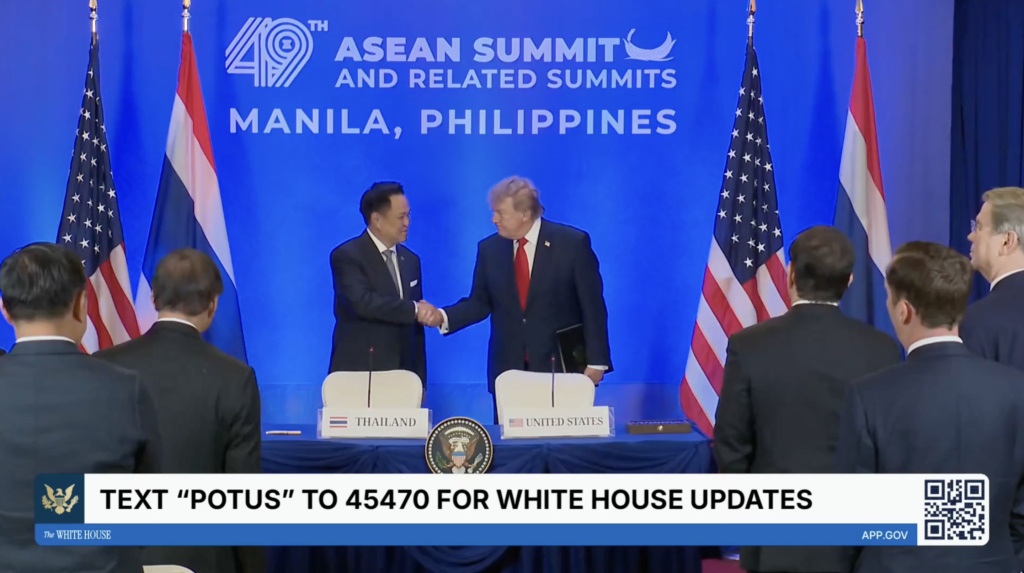
Bloomberg’s Erich Parpart, Suttinee (Ying) Yuvejwattana, and Annmarie Hordern reported that “Thailand and the US have nearly concluded months of trade negotiations after Bangkok made concessions to preserve access to its biggest export market, which buys about a quarter of the country’s overseas shipments.”
Thai Foreign Minister Sihasak Phuangketkeow “confirmed Thailand would move toward zero tariffs and open its market to US pork, which Thai officials had previously described as a negotiating red line. Thailand will also buy American soybeans and other agricultural products, some of which will be used to manufacture goods for export,” Parpart, Yuvejwattana and Hordern reported. “Trump also said Thailand had agreed to eliminate tariffs on US exports and remove significant barriers to American products including vehicles, medical devices, pharmaceuticals, ethanol and poultry. He also cited about $2.6 billion in additional purchases of US agricultural products.”
AgWeb’s Tyne Morgan reported that “this isn’t a trade deal that happened overnight. Just over a year ago, the U.S. and Thailand announced both had agreed to a a framework for an ‘Agreement on Reciprocal Trade.’ A White House fact sheet released with the October 2025 framework had put that figure at 99%, and Thailand has pushed over the past year for additional carve-outs.”
“While no official list has been released from this week’s progress, previous frameworks between the two countries included corn, soybean meal, and dried distillers grains with solubles (DDGS) and ethanol. But for the U.S. Meat Export Federation, it’s a move that could open the door for more pork and beef, as Thailand also signaled they would soften the tariffs on pork,” Morgan reported. “The key now is for the agreement to be signed, and Thailand to follow-through with droppping trade barriers on key products like pork and beef.”
Farms.com’s Diego Flammini reported that “on X, Agriculture Secretary Brooke Rollins called the agreement ‘another BIG trade win for American agriculture!'”
And “at least one industry group is celebrating the improved market access,” Flammini reported. “‘Once finalized, the agreement’s commitment to annual imports will provide a reliable boost in demand for U.S. farmers while the reduction and elimination of other trade barriers will open exciting future opportunities for U.S. feed grains and their co-products,’ Ryan LeGrand, president and CEO of the U.S. Grains & Bioproducts Council, said in a statement. ‘We look forward to the agreement being signed to continue earning international trade wins for U.S. farmers.'”
Thailand Will Nearly Double U.S. Ag Product Purchases
Progressive Farmer’s Chris Clayton reported that “Thailand bought $1.34 billion in U.S. agricultural products in 2025 and was keeping pace at about that level for 2026 so far. Thailand has been a steady, consistent market with sales peaking at $1.69 billion in 2021.”
“Thailand buys mainly grain and feed products, horticultural products, oilseeds and livestock products,” Clayton reported. “Overall, the U.S. operates a significant trade deficit with Thailand. The U.S. exported $19.6 billion in products to Thailand in 2025 while importing $91.3 billion in products. There was a surge from Thailand in 2025 as imports from the country rose 45% that year alone, according to statistics from the U.S. Trade Representative’s Office.”
Trade Deal Implementation Timeline Uncertain
AgroLatam’s Marcus Ellington reported that “for American agriculture, the agreement represents an opportunity to diversify export destinations and strengthen its competitive position in Southeast Asia. However, the actual benefits will depend on final tariff provisions, sanitary requirements and implementation timelines. Although the negotiations signal progress for U.S. agricultural trade, higher export volumes and stronger farm commodity prices are not yet guaranteed.”
