



Massive wildfires have burned vast swaths of grazing lands in Nebraska, endangering cattle producers' plans for production increases that could help ease record-high U.S. beef prices. The loss of grasslands…
USDA Farmer Bridge Assistance Rates Favor Rice, Cotton
Reuters’ P.J. Huffstutter and Julie Ingwersen reported that “the U.S. Department of Agriculture released details on Wednesday about how much row crop farmers will receive next year from a $12 billion aid program, but soybean growers say such payments fall short of helping those hurt by low crop prices and trade disputes.”
“The Farmer Bridge Assistance program is expected to distribute $11 billion in one-time payments to farmers, who will be paid on a per-acre rate if they planted one of the 19 commodity crops identified as being eligible for the program, USDA said in a statement on Wednesday,” Huffstutter and Ingwersen reported. “…While the aid is expected to help farmers prepare for the next planting season, growers and agricultural economists say the payments are a fraction of farm losses and will not rescue the sagging U.S. farm economy.”
“The highest per-acre payments will be paid to rice farmers, who could receive $132.89 an acre; cotton farmers, at $117.35 an acre; and oat farmers, at $81.75 an acre,” Huffstutter and Ingwersen reported. “Meanwhile, farmers are eligible for a payment of $44.36 per corn acre, $30.88 per soybean acre and $39.35 per wheat acre. The payments are calculated using 2025 planted acres, cost-of-production data, and market conditions, USDA said.”
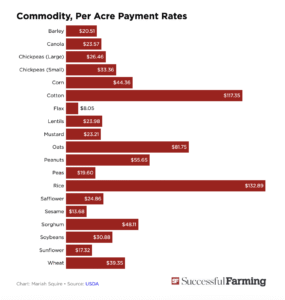
Progressive Farmer’s Chris Clayton reported that “the payment limit will be $155,000 per entity or individual. Unlike other aid programs, USDA will not require ‘linkage’ for crop insurance to receive a payment. USDA, though, also ‘strongly urges’ farmers to use crop insurance and noted certain insurance policies were improved under the One Big Beautiful Bill Act.”
“The FBA payments mark the second round of ad-hoc payments farmers will receive in less than a year. Last spring, USDA released $10 billion in aid because of low prices for the 2024-25 crop under the Emergency Commodity Assistance Program (ECAP) that was funded by an act signed by then-President Joe Biden a year ago,” Clayton reported. “Agriculture Secretary Brooke Rollins said farmers should expect the FBA payments in their bank accounts by Feb. 28.”
“‘These one-time payments give farmers the bridge to continue to feed and clothe America and the world while the Trump Administration continues opening new markets and strengthening the farm safety net,’ Rollins said,” according to Clayton’s reporting.
Ag Groups Split on How Much Aid Will Help
Agri-Pulse’s Steve Davies reported that “row crop groups that responded to the announcement had differing reactions. In a news release, National Cotton Council Chairman Patrick Johnson called the payment rate for cotton growers ‘a welcome and much-needed level of assistance.’ ‘This support is critical for producers struggling to manage current economic pressures and will give lenders and growers the confidence to continue to invest in cotton,’ Johnson said.”
“National Sorghum Producers Chair and Kansas farmer Amy France said the payments ‘provide near-term certainty while longer-term improvements to the farm safety net and risk management tools take effect. That stability matters as growers plan for the upcoming planting season and work through the impacts of a year of lost international trade,'” Davies reported.
Farmer assistance provides needed relief, but it is not enough on its own. Soybean farmers also need strong, reliable markets to ensure long term stability for the U.S. soybean industry.https://t.co/yzOrdtcQT7 pic.twitter.com/f7T5bkIzI8
— American Soybean Association (@ASA_Soybeans) December 31, 2025
“However, the American Soybean Association said the rate for soybean growers isn’t high enough,” Davies reported. “The $30.88/acre for soybeans ‘will not cover the significant financial damage soybean farmers sustained this year due to the high cost of production and losses sustained during the China trade war,’ an ASA press release said.”
Bloomberg’s Michael Hirtzer and Ilena Peng reported that “the National Corn Growers, which represents more than 36,000 US corn farmers, welcomed the assistance but said in a statement that more work is needed to develop markets to provide ‘long-term economic certainty.'”
