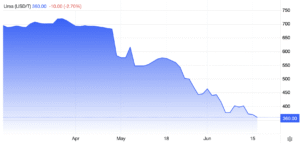
Agri-Pulse’s Kim Chipman, Grace Miller, and Noah Wicks reported that “price indicators for key farm inputs tumbled on Monday following news of the U.S.-Iran preliminary peace deal. The value of urea at New Orleans, a benchmark for North American nitrogen fertilizer, fell about 5% from Friday, or roughly $20, according to Josh Linville, vice president of fertilizer for StoneX.That marks a 53% drop from a high earlier this spring, he says.”
But RFD-TV’s Tony St. James and Marion Kirkpatrick reported that “the price break does not fully solve the farm-cost problem. Linville says today’s urea-to-corn ratio is still 83.5 bushels of corn needed to buy one ton of urea.”
Urea Prices Since April. Courtesy of Trading Economics.
“Phosphate could face more downside if sulfur, ammonia, and Saudi phosphate exports resume. Without price relief, Linville expects phosphate demand to weaken sharply in the fall,” St. James and Kirkpatrick reported. “Potash summer fill programs changed little, but lower grain prices made those values look less attractive. Farmers may need to weigh fertilizer cuts carefully against yield risk.”
Urea Leads Retail Fertilizer Price Declines
Progressive Farmer’s Russ Quinn reported that “average retail fertilizer prices were mostly lower the second week of June 2026 compared to a month earlier, according to sellers surveyed by DTN. The last time most nutrient prices were lower was the first week of February 2026.”
“Prices for five fertilizers were lower compared to last month, while prices for the remaining three fertilizers were slightly higher. DTN designates a significant move as anything 5% or more,” Quinn reported. “Leading the nutrients lower was urea. The nitrogen fertilizer’s price was 12% lower than a month ago, at $764 per ton. UAN32 was 5% less expensive than the previous month. The nitrogen fertilizer had an average price of $569/ton.”
“The remaining three fertilizers were just slightly less expensive than a month ago: DAP had an average price of $909/ton, anhydrous $1,092/ton and UAN28 $531/ton,” Quinn reported. “Three fertilizers were slightly more expensive compared to last month: MAP had an average price of $955/ton, potash $494/ton and 10-34-0 $723/ton. On a price per pound of nitrogen basis, the average urea price was $0.83/lb.N, anhydrous $0.67/lb.N, UAN28 $0.95/lb.N and UAN32 $0.89/lb.N.”
“All eight fertilizers are now higher in price compared to one year earlier: Potash (by 4%), 10-34-0 (8%), DAP (13%), both MAP and UAN32 (15%), urea (16%), UAN32 (27%) and anhydrous (41%),” Quinn reported.
Fertilizer Backlog at Strait of Hormuz May Not End Quickly
Bloomberg’s Eleanor Thornber reported that “an interim US-Iran deal to end their months-long war and potentially fully reopen the Strait of Hormuz is unlikely to immediately ease fertilizer flows as shipowners wait for more details to assess the safety of transits.”
“A vital conduit for global commodity trade, Hormuz has been effectively closed since the first strikes on Iran at the end of February,” Thornber reported. “Even once there is more clarity on the resumption of trade through the waterway, market watchers expect movement of the crop nutrients to be gradual as hundreds of vessels stranded in the region — carrying a variety of cargo — compete for access.”
“There are over 40 vessels laden with fertilizer in the strait, according to tanker-tracking data compiled by Bloomberg and Kpler,” Thornber reported. “A trickle of ships have made it out since the conflict began, but weekly exports are down 90% from pre-conflict levels, Kpler data show, with flows falling from nearly 600,000 tons a week in late February to 60,000 tons in early June.”
“Also, fertilizer cargoes are unlikely to be among the first shipments to move. Hormuz is crucial for global energy flows and analysts expect oil and LNG tankers to receive priority,” Thornber reported. “‘When it comes to moving ships through the Strait of Hormuz, it’s going to be oil tankers and LNG carriers that are top of the list once we get towards a more normal flow of traffic,’ said Alexis Ellender, senior dry bulk lead at Kpler. ‘Fertilizer is not as high a priority.'”