Skip to content

Inflation-Adjusted Midwest Farmland Values Fall Most Since 2016

ProFarmer’s Mike Walsten reported that “farmland values for the Central Corn Belt were flat in the second quarter of 2026 from a year earlier, reports the Federal Reserve Bank of Chicago. This is the slowest year-over-year growth since the fourth quarter of 2024, the bank notes.”

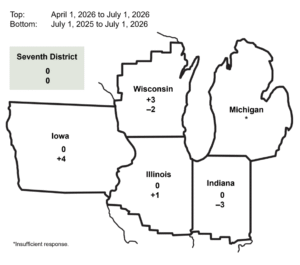
“Values for ‘good’ agricultural land also showed no change in the second quarter of 2026 relative to the first quarter, according to survey responses from agricultural lenders in Illinois, Indiana and Iowa,” Walsten reported. “Illinois and Iowa farmland values saw year-over-year increases, while Indiana and Wisconsin farmland values note year-over-year decreases.”

But “in real terms (after being adjusted for inflation with the Personal Consumption Expenditures Price Index, or PCEPI), there was a year-over-year decrease of 3.7% in district ag land values,” Walsten reported. “‘This is the largest year-over-year decline in real farmland values for the district since the third quarter of 2016,’ the bank states.

Percent change in dollar value of “good” farmland. Courtesy of the Chicago Federal Reserve.

“Only 5% of the respondents believe farmland values will rise in the third quarter of 2026, while 81% anticipate them to be stable and 14% expect them to fall,” Walsten reported. “A large share of survey respondents (43%) say farmland is overvalued; 57% viewed farmland as appropriately valued (not a single respondent reported it as undervalued).”

The low number of respondents believing that farmland values will rise in the third quarter of 2026 is in line with results from the August Ag Economy Barometer, which reported that “the Short-Term Farmland Value Expectations Index declined from 124 in June to 119 in July, and the long-term index decreased from 166 to 152. Alternative investments, net farm income, and interest rates were cited as the three factors with the greatest influence on farmland values.”

Lenders Say Solar and Data Centers Propping up Farmland Values

Progressive Farmer’s Todd Neeley reported that “what’s more, the lenders responding to the survey said they were noticing an emerging factor propping up land values.”

“‘Several lenders commented that investment activity for data centers and solar and wind farms helped hold up agricultural land values,’ according to the report,” Neeley reported. “One Wisconsin lender surveyed responded: ‘At some point, farmland values should plateau as outside pressure from solar and data centers subsides.'”

Credit Conditions Also Weaken Compared to a Year Ago

ProFarmer’s Walsten reported that “agricultural credit conditions were weaker in the second quarter of 2026 compared with a year ago.”

“The share of farm loans with ‘major’ or ‘severe’ repayment problems in the district’s agricultural bank loan portfolio (as measured in the second quarter of every year) was 3.7% in 2026, up from last year’s level of 2.9% and the highest reading since 2020,” Walsten reported. “Furthermore, the share of farm loans with ‘no’ repayment problems declined to 88.5% from 90.1% a year earlier. In addition, repayment rates for non-real-estate farm loans were lower in the second quarter of 2026 compared with a year ago. Renewals and extensions of such loans were higher.”

Neeley reported that “the analysis quoted an unnamed Iowa lender: ‘Commodity price volatility and elevated production expenses are the factors weighing most heavily on credit conditions.’

“In addition, the Seventh District’s average loan-to-deposit ratio increased to 80.7% in the second quarter of 2026 — the highest number since collection of data began in the 1970s,” Neeley reported. “‘Over the first half of 2026, district banks made more farm operating loans and farm mortgages than normal, according to responding lenders,’ the report said. ‘Over the same time period, lenders reported that Farm Credit System institutions, as well as merchants, dealers and other input suppliers, lent more funds to the agricultural sector than normal, while life insurance companies lent less.'”

Read the report here: https://www.chicagofed.org/publications/agletter/2025-2029/august-2026

Ryan Hanrahan is the Farm Policy News editor and social media director for the farmdoc project. He has previously worked in local news, primarily as an agriculture journalist in the American West. He is a graduate of the University of Missouri (B.S. Science & Agricultural Journalism). He can be reached at rrh@illinois.edu.

Back To Top