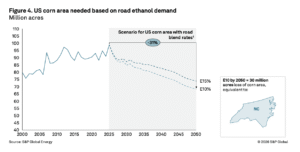
Progressive Farmer’s Jake Zajkowski reported that “a new report from U.S. Farmers and Ranchers in Action and its partners predicts the U.S. could lose roughly 30 million corn acres by 2050 if new sources of feed demand are not found and the ethanol blending rate remains at 10%.”
“The study, completed by S&P Global Energy’s consulting group, created a high-growth, optimized scenario where technology is not limited by food and fuel demand,” Zajkowski reported. “New markets, such as year-round E15, maritime fuels and aviation fuels, could pave the way for farm profitability and rural prosperity.”
“The report entitled ‘Fueling Agriculture: Biofuels as The Catalyst’ said a higher blend rate, in addition to a convergence of technology, would ‘lift U.S. corn yields by 1.6% annually through 2050, unlocking nearly 50% more production without expanding acreage,'” Zajkowski reported. “At the current blend rate, the U.S. would progressively lose ethanol market share as gasoline consumption declines, resulting in a loss of 6.6 billion gallons of ethanol demand by 2050. The land mass lost, the report estimates, would be 30 million acres, equivalent to halting production on a land mass the size of North Carolina.”
US corn area needed based on road ethanol demand. Courtesy of S&P Global Energy.Bloomberg’s Elizabeth Elkin reported that “expanding biofuel demand would allow agricultural production to remain strong, serving as a ‘reliable long-term supplier’ of corn, ethanol and other products to domestic and international markets, the report said. About 83% of the net increase in corn demand since 2000 has been attributed to ethanol expansion, according to the study.”
“The conclusion comes after the US in March finalized its most aggressive biofuel blending mandates to date. While the requirements were welcomed by farm groups, they left conventional biofuel volumes — mostly corn ethanol — largely unchanged. Current blending levels also fall short of those requirements,” Elkin reported. “Many believe the easiest way to fill the gap would be to expand the market for corn-based ethanol by allowing year-round, nationwide sales of higher-ethanol E15 gasoline.”
“Yet efforts to authorize permanent E15 sales have failed for more than a decade, largely due to opposition from much of the oil industry, which has argued that biofuel blending mandates impose significant costs on refiners,” Elkin reported. “‘Somebody’s going to benefit from this in every state,’ Senator Chuck Grassley, a Republican from Iowa, said about E15 legislation at a Tuesday event launching the report. ‘But we’ve got to move, and it’s almost too late now if we don’t get some action.'”
Year Round E-15 Legislation Uncertain in Senate
E&E News’ Marc Heller reported that “a yearslong campaign for higher ethanol fuel is facing a now-or-never moment, the Senate’s leading advocate said Tuesday.”
“Sen. Chuck Grassley (R-Iowa) gave that stark scenario for E15 — the gasoline blend that’s 15-percent corn-based ethanol — in a conference call with reporters as lawmakers search for a legislative path to lift summer restrictions on its sale,” Heller reported. “‘If we don’t get E15 this year, we’re never going to get it,’ Grassley said on a weekly call with agriculture reporters.”
“The opportunities are narrowing for Grassley and other E15 advocates who say they’re on the cusp of the long-sought goal, which could spur millions of acres of additional corn production by some estimates,” Heller reported. “The House passed an E15 bill as a stand-alone in May, but that’s a tough sell in the Senate, where 60 votes are needed to pass most bills and opponents could be expected to bog down the measure with amendments.”
Study Says Farmers Could Support Threefold Expansion in Biofuels by 2050
Agri-Pulse’s Kim Chipman reported that U.S. Farmers and Ranchers in Action Chief Executive Officer Kevin Burkum “said the S&P study is groundbreaking because it makes clear that sustaining investment in U.S. agriculture will require higher demand. ‘If we allow farmers to expand into new markets for biofuels, we can transform American agriculture, revitalize rural incomes and provide global food and energy security,’ he said.”
“The study finds that farmers could support a threefold expansion in biofuels production by 2050 and that renewable fuels could capture more of the nearly 940-billion-gallon global liquid fuels market, including aviation and marine fuels,” Chipman reported.