Progressive Farmer’s Chris Clayton reported that “farmers will get a two-month reprieve on their crop insurance premiums this year and USDA will also reinstate prevented planting buy-up coverage as well, Agriculture Secretary Brooke Rollins announced Tuesday.”
“Rollins spent Tuesday morning at the Farmfest show in south-central Minnesota, making announcements on crop insurance and detailing USDA’s plans to modernize and improve data collection for crop reports,” Clayton reported. “The Risk Management Agency (RMA) will provide farmers with 60 additional days to pay crop insurance premiums. The scheduled premium billing dates between July 1 and Sept. 30 will be extended 60 days by crop insurance providers.”
“‘For some of you, that may not be a big deal, but I know for others of you, that’s a really, really big deal,’ she said,” according to Clayton’s reporting. “During that extended period, approved insurance providers ‘may waive interest charges,’ Rollins said. Interest will begin accruing for unpaid premium and administrative fees only after the end of the additional 60-day period, she said.”
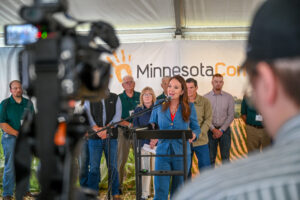
USDA Secretary Brooke Rollins speaks at Minnesota Farmfest on Aug. 4, 2026. Courtesy of Brooke Rollins.Agri-Pulse’s Noah Wicks reported that “Rollins also stated the agency would be reinstating the buy-up coverage option for prevented planting, which allows producers to choose to pay a slightly higher premium to qualify for an indemnity payment 5% higher than the basic coverage.”
“The agency eliminated the option last November, though the decision sparked backlash from farmers in Arkansas, North and South Dakota, and in other states prone to spring flooding,” Wicks reported. “Rollins said she hoped reinstating the option will provide producers a ‘bigger and better opportunity to manage risk in situations where extreme weather or other conditions prevent normal planting.'”
“‘Taken together, these actions… underscore our continued commitment to listen, to learn, to adapt, to adjust, and to make quick decisions to continue to support you during this challenging period,’ Rollins said of the crop insurance and prevented planting announcements,” Wicks reported.
Rollins Also Announces Data Roundtable Discussions
AgroLatam’s Marcus Ellington reported that Rollins also “outlined USDA’s strategy to modernize the National Agricultural Statistics Service (NASS) through its ‘One Farmer, One File’ initiative. The secretary acknowledged that farmer participation in USDA surveys has declined dramatically over the past three decades, falling from approximately 85% in 1992 to between 38% and 45% today.”
“Lower participation threatens the accuracy of USDA crop reports, including production estimates and the closely watched WASDE reports that influence commodity prices, marketing decisions, and farm policy,” Ellington reported. “USDA plans to conduct additional producer roundtables throughout August across several Midwestern states to gather feedback on improving data collection.”
At Minnesota Farmfest, @SecRollins today announced several steps USDA is taking to support America’s farmers, including a series of listening sessions across the country to hear directly from farmers as USDA rolls out a Data Modernization Plan across multiple agencies.…
Clayton reported that “the secretary said USDA will work on modernization plans that will make it easier for farmers to fill out the surveys. ‘We want to make it easy, we want to make it efficient, we want to make it the gold standard again,’ she said.”
“Asked about how those data collection efforts will coincide with USDA’s reorganization plans, Rollins said too many agency staff work in Washington, D.C., and USDA’s goals are to bring those people closer to those they serve,” Clayton reported. “…Rollins did not address whether staff losses at NASS would affect USDA’s ability to improve its crop reports and survey responses.”