AgDaily reported that “the U.S. Department of Agriculture has raised its forecast for U.S. farm income in 2026, but the improved headline number masks a more difficult financial picture for farmers as production expenses climb, debt increases and government payments account for a growing share of sector income.“
“The agency’s September farm income forecast projects net farm income at $158.4 billion in 2026, up $5 billion from its February forecast,” AgDaily reported. “Still, that would represent a $4.3 billion, or 2.6 percent, decline from the newly revised 2025 estimate of approximately $162.7 billion. Adjusted for inflation, net farm income is expected to fall $9.1 billion, or 5.5 percent.”
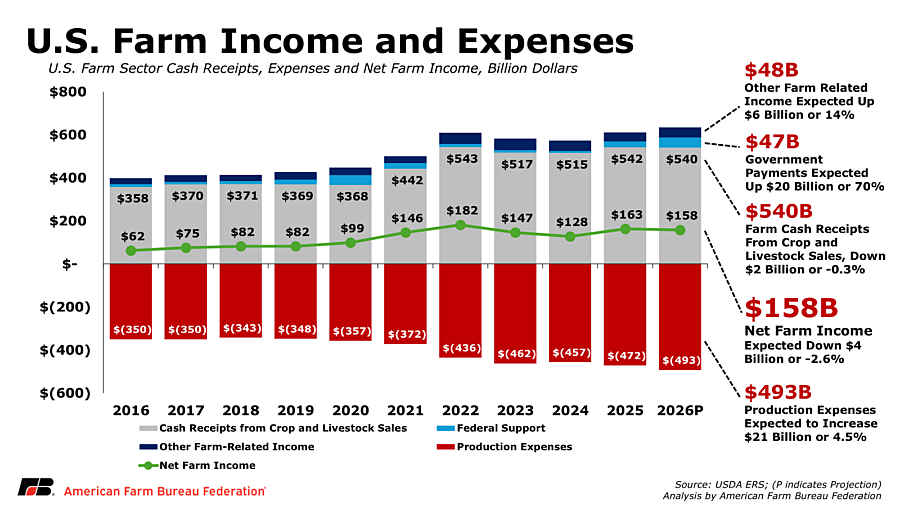
“The latest numbers represent a notable change from the USDA’s February outlook. While the agency increased its 2026 forecast by $5 billion, it raised its estimate for 2025 by an even larger $8.1 billion,” AgDaily reported. “That means the year-over-year decline is now expected to be greater than previously anticipated. In February, the USDA projected net farm income would decline just 0.7 percent in nominal terms and 2.6 percent after inflation in 2026. The September forecast puts those declines at 2.6 percent and 5.5 percent, respectively.
Production Costs Forecast to Reach Record High in 2026
The American Farm Bureau Federation’s Faith Parum and Daniel Munch reported that “production costs are one of the most significant changes in USDA’s September outlook. Total farm production expenses are now forecast at $492.8 billion in 2026, up $21.2 billion, or 4.5%, from 2025 and $15.1 billion above USDA’s February forecast. After adjusting for inflation, expenses are now expected to rise 1.5%; in February, USDA projected a 0.9% decline.“
“Several major categories are moving higher,” Parum and Munch reported. “Livestock and poultry purchases are projected to increase $7.4 billion, or 11.4%, to $71.9 billion, while fertilizer, lime and soil conditioner expenses rise $5.3 billion, or 15.3%, to $39.6 billion and fuel and oil costs increase $4.8 billion, or 28.8%, to $21.6 billion.”
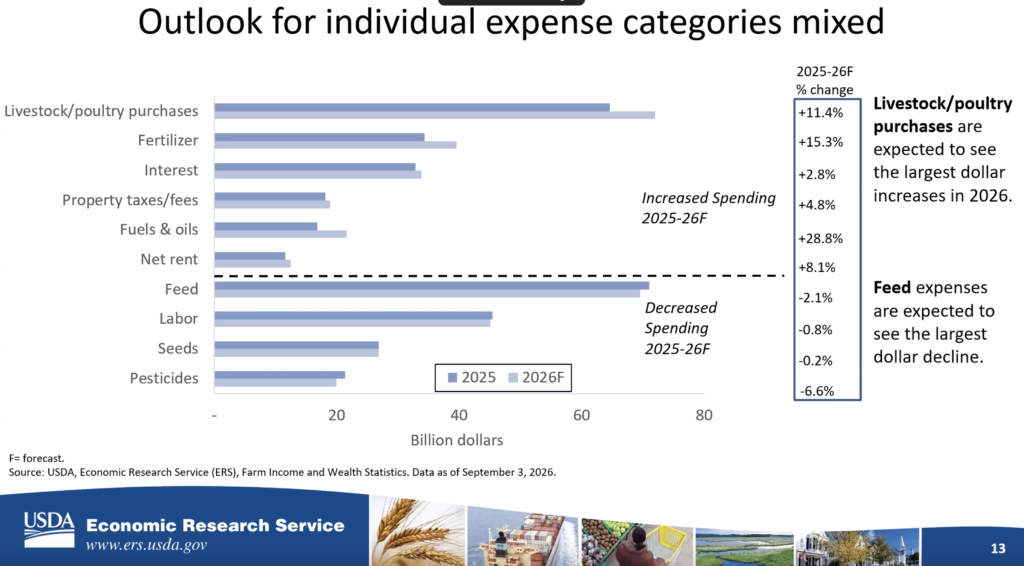
“The sharp increases now projected for fuel and fertilizer are particularly important given renewed conflict in the Middle East. Fighting involving Iran has again disrupted traffic through the Strait of Hormuz and pushed Brent crude above $96 per barrel, increasing the risk of further pressure on energy, transportation and fertilizer costs,” Parum and Munch reported. “Taken together, USDA’s updated estimates suggest that meaningful expense relief remains limited. Even where individual costs ease, total production expenses remain elevated, leaving farm margins vulnerable to weaker commodity prices and renewed input-cost shocks.”
Crop Picture Brightens
AgDaily reported that “for crop producers, the USDA’s latest numbers offer some brighter spots. Total crop cash receipts are forecast at $253 billion in 2026, an increase of $14.6 billion, or 6.1 percent, from 2025. That is also more than $12 billion above the USDA’s February projection. Even after accounting for inflation, crop receipts are expected to increase 3.1 percent.”
“Corn receipts are projected to climb $6.8 billion, or 11.3 percent, to $67.3 billion, driven largely by greater quantities sold,” AgDaily reported. “Soybean receipts are expected to increase $4.3 billion, or 10 percent, to $47.9 billion, primarily because of higher prices. Cotton receipts are forecast to rise 12.5 percent to $5.9 billion.”
Cattle Remains Bright Spot for Livestock
Agri-Pulse’s Steve Davies and Noah Wicks reported that “when it comes to livestock, ERS expects total animal cash receipts to fall $16.4 billion, or 5.4%, in nominal terms, with egg prices expected to contribute to most of the decline. However, cattle and calf receipts are expected to grow from $133.7 billion to $140.7 billion, according to the forecast.“
“Brad Lubben, director of the North Central Extension Risk Management Education Center at the University of Nebraska-Lincoln, called the current ag economy ‘a tale of two farms,'” Davies and Wicks reported. “‘The ranch, or more specifically the livestock sector, has been enjoying record prices and record returns,’ Lubben said at the annual Flinchbaugh Forum at Kansas State University on Thursday. ‘The farm on the crop side has been struggling, or at least going downhill, since records of 2022.'”
