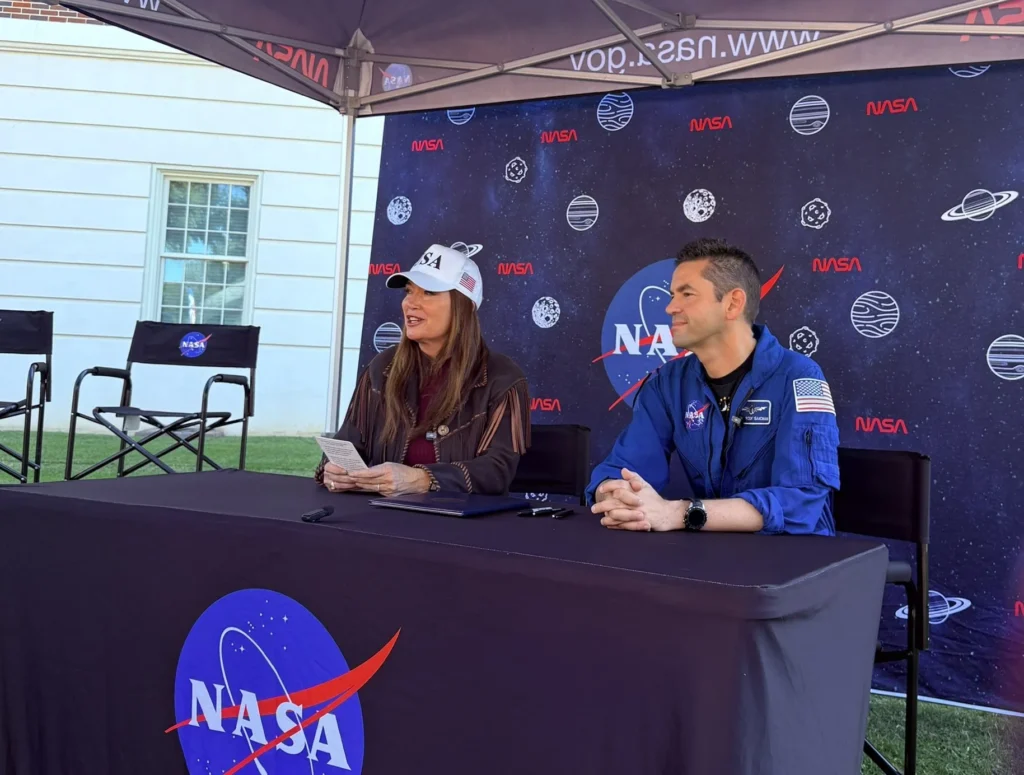
Agri-Pulse’s Kim Chipman, Olivia M. Bridges, and Noah Wicks reported that “Agriculture Secretary Brooke Rollins and National Aeronautics and Space Administration Administrator Jared Isaacman signed an interagency agreement to modernize USDA data, including agricultural statistics, remote sensing science, modeling, geospatial data engineering and super intelligence or machine learning.”
“‘American farmers are the best in the world and deserve any solution we can leverage, even when it is out of this world,’ Rollins said, adding that using NASA’s technology, research and development will fortify U.S. agriculture,” Chipman, Bridges and Wicks reported. “The cooperation aims to align USDA statistical requirements with NASA Earth science missions and data products. USDA and NASA also will undergo discussions related to data access and infrastructure and jointly review algorithms for crop condition indicators, yield models, planted/harvested area estimation and disaster impact assessment.
ExecutiveGov’s Sophia Elliott reported that “planned activities include:
- Mission and data alignment: Regular technical exchanges to match USDA’s statistical needs with NASA Earth science missions and data products, such as satellite observations and model outputs.
- Data access and infrastructure: Discussions on scalable access to NASA archives, cloud-native geospatial formats, application programming interfaces and workflows that support USDA operations.
- Methodology and validation: Joint reviews of algorithms for crop condition indicators, yield models, planted and harvested area estimates, and disaster impact assessments.”
Meat & Poultry’s Erica Shaffer reported that “the collaboration is part of USDA’s efforts to improve data collection after inconsistent crop reports drove a decline in producers survey participation.”
“‘American farmers are the best in the world and deserve any solution we can leverage, even when it is out of this world,’ said Secretary of Agriculture Brooke L. Rollins. ‘I am proud to announce that USDA will now work with Administrator Isaacman and NASA to utilize the full power of technology, research and development to fortify US agriculture,'” Shaffer reported. “‘With this unprecedented partnership the Trump Administration is committing to a bright future of research and tech opportunities that will enhance USDA acreage and yield estimation and drive profitability for American agriculture,’ Rollins said.”
MOU Announced as USDA Admits Processing Error in September Corn Data
The signing of the MOU with NASA came just one day after the USDA admitted it found a processing error that caused incorrect September 2026 corn plant populations, ear counts, yields and production estimates for Kansas and Nebraska — further driving producer distrust in USDA data.
Now, AgWeb’s Tyne Morgan reports that “USDA has revealed the cause of the data error in its September corn estimates, acknowledging that incorrect acreage weights were used to combine irrigated and nonirrigated field observations. The error affected September plant populations, ear counts and yield forecasts for Kansas and Nebraska, the 10-state regional averages and national figures.”
“While NASS said the issue was confined to a calculation mistake, Chip Flory, Farm Journal economist and host of AgriTalk AM, still has questions about the data behind the estimates,” Morgan reported. “‘The fact that USDA now says, ‘The review identified a September processing error involving incorrect acreage weights used to combine irrigated and non-irrigated objective yield observations for Kansas and Nebraska,’ certainly makes this look like an accounting error and nothing more,'” Flory said. ‘”However, as I have asked questions at different levels of this process, there are questions that remain unanswered about the data-gathering from the objective yield plots in September.'”
