Agri-Pulse’s Philip Brasher reported that “the Trump administration is discussing some type of ‘bridge’ financial assistance to help farmers make it into 2026, says Deputy Agriculture Secretary Stephen Vaden.”
“Talking to reporters at the Farm Progress show in Decatur, Illinois, on Tuesday, Vaden provided no details of what the assistance would look like, but he noted that the department’s spending authority under the Commodity Credit Corporation (CCC) would typically be refreshed in November,” Brasher reported. “…Congress enhanced the two main commodity programs for row crops, Price Loss Coverage and Agriculture Risk Coverage, in the budget reconciliation law enacted in July, but farmers won’t see any payments as a result of those changes until October 2026.”
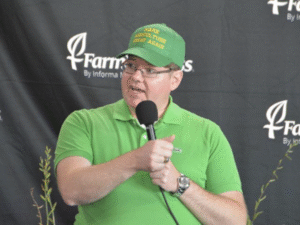
“‘We’re seeing the same thing that farmers are seeing with regard to commodity prices, and we know that many of the most important pieces of the One Big Beautiful Bill don’t come into effect until 2026. … So, we’ve got to get them from this growing season to the next growing season,’ Vaden said,” according to Brasher’s reporting. “He added, ‘We are seeking to develop policy solutions to bridge that … and that’s what the secretary and I are working on, and what she’s constantly talking to not only the president but other members of her cabinet about. You can rest assured that when we have those announcements to make, we’ll do it.'”
Progressive Farmer’s Chris Clayton reported that “the Trump administration in 2018-19 tapped the CCC for more than $23 billion for commodity producers primarily to support declines in crop prices due to the trade war with China. It’s possible a similar scenario could come into play, though Vaden didn’t specifically spell that out in his comments.”
“Vaden pointed out USDA has paid more than $8 billion in Emergency Commodity Assistance Program (ECAP) aid payments for 2024 crop losses and another $4 billion in the Supplemental Disaster Relief Program for at least some of the crop and livestock losses in 2023 and 2024,” Clayton reported. “Vaden noted there should be some future announcements in September for farmers to file other disaster claims for 2023 and 2024 crop losses that were not covered by crop insurance.”
Ag Leaders Continue to Push for More Market Access
Progressive Farmer’s Clayton reported in a different article that “with large crops and low prices, leaders representing corn and soybean farmers are pressing the need for more demand for their crops, whether it is selling more biofuels or re-establishing export sales with China. Asked about the prospect of aid payments, farm leaders described potential ad-hoc government payments as a ‘Band-Aid on a gushing wound’ that won’t solve the underlying problems.”
“Each group sees a different need for their crops,” Clayton reported. “The American Soybean Association is pressing the Trump administration to reach a trade deal with China. The lack of China buys for the 2025-26 crop year leaves a gaping hole in demand that can’t be replaced. The National Corn Growers Association wants Congress to approve year-round E15 before the end of the year. Corn exports are already strong, but E15 legislation would greenlight ethanol producers to increase their production.”
“Scott Metzger, a farmer from Williamsburg, Ohio, and a vice president for ASA, said his area of Ohio suffered a drought last year that brought down production. The lower production has been compounded with the current low prices. Farmers in his area have seen their working capital eroded, he said,” Clayton reported. “‘It’s tough, and working capital is something that takes a little bit of time to build back up,’ he said. ‘You just don’t do that overnight.'”
Matt Frostic, a farmer from Applegate, Michigan, and an NCGA board member “credited Congress and the Trump administration for passing a stronger safety net for commodity producers, though those price supports won’t kick in until fall 2026. ‘While we’re appreciative about getting that policy across the board, we’ve got a crisis right now to work on and deal with this fall,’ Frostic said. ‘We’re going to get to where we are profitable again, but it’s going to take some time.'”