Pro Farmer’s Spencer Langford reported that “the number of U.S. farms shrank by 15,000 in 2025, bringing the total to 1.865 million, USDA said (last week) in its Land in Farms report.”
“This continues a long-lasting trend of declining farm numbers. Analysis from the American Farm Bureau Federation noted that farm bankruptcies were also on the rise,” Langford reported. “The largest decline at the state-level was Texas, which lost 2,000 operations. No state saw an increase in farms, but multiple states did indicate no change from the prior year.”
In the Midwest, Illinois saw a loss of 400 farms to 69,600, Iowa saw a loss of 500 farms to 86,200, Indiana saw a loss of 500 farms to 51,500, Nebraska saw a loss of 200 farms to 44,100 and Minnesota saw a loss of 1,300 farms to 64,000. Texas remains the state with the highest number of farms, far outpacing all others at 229,000.
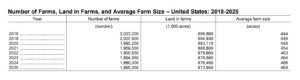
“The number of farms decreased in every economic category except for farms making 1 million dollars or more in sales each year, which saw a minor increase of 50 farms. Farms making $1,000-$9,999 in sales posted the largest loss of any category, falling by 8,000,” Langford reported. “The total amount of land in farms came in at 873.95 million acres, a 0.3% decrease from the 2024 figure. Farmland continues to face pressure from economic factors such as urbanization and low or negative returns per acre, particularly in row crops.”
Dairy Operations Continue Decline in Upper Midwest
Wisconsin Public Radio’s Hope Kirwan reported that “for decades, the number of dairy farms operating in Wisconsin has been declining. The latest licensing data shows there were about 5,100 dairy herds operating in the state at the start of 2026. That’s just over half of the number of farms operating 10 years ago, and roughly a third of the number of farms that were licensed two decades ago.”
“But the decline in dairy herds doesn’t mean there are fewer cows being milked. In fact, the number of cows being milked in America’s Dairyland is about the same as it was two decades ago, and the state’s farmers are producing slightly more milk every year,” Kirwan reported. “Consolidation continues to be the biggest factor shaping the number of farms in the state, according to Steven Deller, agricultural and applied economics professor at the University of Wisconsin-Madison.”
“Deller said the high costs farmers face to produce milk continues to make it difficult for small and mid-size farms to be profitable. That’s compounded by the fact that the average age of farmers in the state continues to grow older,” Kirwan reported. “‘If you’re in your mid-60s, it just doesn’t make sense to be operating a dairy farm with 150 cows,’ he said. ‘That’s demanding work, that’s really hard labor, and you hit a certain point where you just say, ‘I can’t do this anymore.’”
Current State of Ag Economy Could Accelerate Consolidation
AgWeb’s Tyne Morgan reported that “the U.S. ag economy enters 2026 in a clear crop-sector recession, but the deeper crisis is one of confidence. High input costs, weak prices, policy uncertainty and eroding trust in data have pushed many producers from planning for profitability into fighting for survival. Economists largely view the downturn as cyclical and manageable through optimization, while farmers experience it as a structural stress test on their operations and livelihoods.”
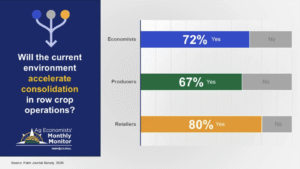
“On the state of the economy itself, there is little debate: 76% of economists say the U.S. crop sector is in a recession. 74% of producers agree. More than 76% of economists believe conditions are worse than a year ago,” Morgan reported. “Economists warn this environment is accelerating consolidation, with 72% expecting low prices and high costs to push weaker operations out of the market with 80% of retailers saying it will increase consolidation in the industry.“