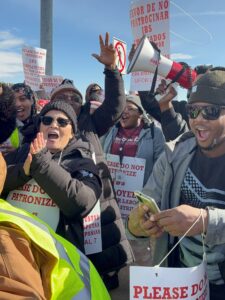
Reuters’ Tom Polansek reported that “striking JBS employees took to the streets of Greeley, Colorado, before sunrise on Monday to picket against the world’s largest meat company, in a rare labor stoppage at a U.S. meatpacking plant and a sign of upheaval in the beef industry.”
“The union representing about 3,800 employees at the beef processing facility said it was the first time U.S. meatpacking workers had gone on strike in four decades. They launched a two-week strike and will remain on the picket lines until JBS negotiates fairly with workers, the union said,” Polansek reported. “Workers have faced off with the company over wage increases they say fall short of inflation, and over charges for safety equipment. JBS has said it made a fair offer.”
“The dispute reduces U.S. beef production capacity at a time when consumers face record prices for hamburgers and steaks and President Donald Trump has struggled to make good on a pledge to cool costs,” Polansek reported. “Prices soared after a years-long drought burned up grazing lands and drove ranchers to slash their herds to the lowest level in 75 years.”
“Normally, meatpackers briskly slaughter cattle to feed retail demand for beef. But tight cattle supplies have forced processors to pay steep costs for cattle, likely leaving JBS less incentivized to resolve the strike quickly, economists said,” according to Polansek’s reporting. “‘Why would you be in a hurry if you’re already losing money on running that plant?’ said Altin Kalo, economist for Steiner Consulting Group.”
Extended Strike Could Hit Beef Prices
Bloomberg’s Ilena Peng reported that “the strike comes as the meatpacking industry is facing a severe cattle shortage after ranchers shrunk their herds due to high production costs and droughts. The US herd at the smallest level in decades has sent prices soaring, with beef becoming an affordability issue in an election year as one of the biggest drivers of food inflation every month.”
“The labor action at JBS when slaughter is so low will increase beef prices, ADM Investor Services’s Chris Lehner wrote in a note last week,” Peng reported. “‘It is likely beef buyers have been increasing contracting beef ahead of it, but it will also limit the amount of beef available on the daily market,’ Lehner said.”
The Associated Press’ Brittany Peterson, Matthew Brown and Morgan Lee reported that “an extended dispute with the Greeley workers could disrupt the industry, particularly in Colorado and neighboring states, said Jennifer Martin at Colorado State University’s animal sciences department.”
“‘The feedlots, the people who have the cattle right now — the longer they sit kind of in a holding pattern, the more expensive they become to feed,’ said Martin,” according to the Associated Press reporting. “‘For consumers, it means that prices will likely go up.'”
The line is strong. The voices are loud. The workers are united.
Members of United Food and Commercial Workers Local 7 are out in force at JBS USA in Greeley, marching together and demanding dignity on the job. pic.twitter.com/X11QvisDXC
— UFCW Local 7 (@UFCW_7) March 17, 2026
“The impact of the strike could be tempered as JBS said it can maintain supply by temporarily shifting production to other facilities,” Peng reported. “Still, it’s the latest disruption to hit the industry. Meatpackers have been pulling back amid the severe shortage, with Tyson Foods Inc. shutting a cattle slaughtering plant in Nebraska and reducing operations at a Texas facility. Cargill Inc. said last month it would close a ground beef plant in Milwaukee, while JBS said it would close a meat-processing plant in California.”
“JBS, the US’s largest beefpacker, processes 28,000 cattle per day across its US plants, according to its website, and the Greeley facility has capacity for 5,000 to 6,000 animals, the Colorado Times Recorder reported,” according to Peng’s reporting. “That makes the plant potentially the largest for slaughter-ready cattle in the US, Ben DiConstanzo, a senior livestock analyst at Walsh Trading, said.”