



E&E News’ Grace Yarrow reported that, “Bayer is withdrawing its request that the Trump administration impose countervailing duties on glyphosate imports from China after backlash from the agriculture industry.” “The…
Accelerated Permitting, Grant Program to Boost Domestic Fertilizer, USDA Says
The United States Department of Agriculture is taking new steps to expand domestic fertilizer production, Secretary Brooke Rollins said at a press conference Tuesday, including accelerated permitting and the reviving of a Biden administration grant program to boost U.S. fertilizer production.
The aim of the new moves is to boost domestic fertilizer production by about 4.5 million tons per year, supporting roughly 400,000 producers and 290 million acres of farmland, Rollins said, though she didn’t provide a time estimate of when new fertilizer production could actually be online and available for farmers.
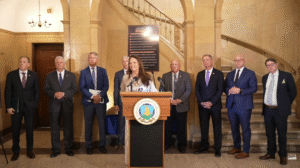
“Every tool in the toolkit has to be reviewed and analyzed. We are very bullish on this potential policy plan that we’re putting into place,” she said. “For the long term, we’re fixing this. For the short term, until the conflict is over in Iran, we’ll continue to look at things like lifting the countervailing duty in Morocco, lifting transport rules, etc.”
Officials Say They Will Accelerate Permitting for Fertilizer Projects
Progressive Farmer’s Chris Clayton reported that “in their efforts to show the Trump administration is focused on bringing down fertilizer prices, Agriculture Secretary Brooke Rollins led another press event on Tuesday at USDA’s headquarters in Washington, D.C., to tout the permitting push for what will be considered ‘the world’s largest low-carbon ammonia production facility,’ led by CF Industries.”
On the $4 billion Blue Point low carbon-ammonia plant, “Adam Tell, the assistant secretary for the Army for Civil Works, said, ‘this project was mired in Green New Deal red tape,’ but the Trump administration expects to announce a decision on it within 45 days,” Clayton reported. “Tell also said the Army Corps of Engineers in the past few days has issued a memorandum to all 39 districts that fertilizer projects should not be deterred by red tape.”
“EPA Administrator Lee Zeldin also said permits needed for the Clean Air Act or Clean Water Act are also being accelerated,” Clayton reported. “‘Bringing down costs on farms has been a very important priority of President Trump, specifically with his engagement with EPA,’ Zeldin said. ‘He understands that our farmers have inherited so many hurdles by our predecessors, and he wants those obstacles to be blazed through instantly.'”
“Energy Secretary Chris Wright said the U.S. is the ‘hydrocarbon superpower of the world’ and the administration is doing everything it can to reverse policies of the Biden administration that increased costs, mainly by lowering greenhouse gas emissions,” Clayton reported. “‘You heard about this fabulous Blue project in Louisana that will become the world’s largest ammonia fertilizer production plant?’ Wright said. ‘The Biden administration wanted it to have carbon capture – wanted it to fit their climate crazy agenda – and it stalled that plant that should be feeding American farms today. But that permit will be issued soon, and that plant will be up.'”
Reviving Biden Administration Fertilizer Grant Program
Agri-Pulse’s Steve Davies reported that “at an event at the Agriculture Department Tuesday, Ag Secretary Brooke Rollins said the Fertilizer Production and Expansion Program would be reimagined to boost U.S. fertilizer capacity. The program, Rollins said, was ‘originally conceived with a very good thought in mind, and that is, we have to reshore/onshore our fertilizer production here in America.’ However, she said it was focused too much on mitigating climate change and not enough on making fertilizer.”
“Of 121 projects targeted for funding by the previous administration, ‘only eight were moved to completion,’ Rollins said. ‘Seven were marked unsatisfactory,’ she added, and ‘in most instances there was zero contact information reported for the awardees,'” Davies reported. “‘We have now changed that,’ she said. ‘We are in touch with every single one of them. We are talking to them. Those projects that were stalled because of climate requirements are now coming back online.'”
Three major steps we announced today to strengthen American fertilizer production and support our farmers and ranchers. 🇺🇸 🚜
1️⃣ The Blue Point Project in Louisiana is moving at “Trump speed.”
Within 45 days, permitting is expected to wrap up for a $3.7 BILLION ammonia plant… pic.twitter.com/gxYzXzAm0R
— Secretary Brooke Rollins (@SecRollins) May 19, 2026
Brownfield Ag News’ Carah Hart reported that “Rollins says the agency has restarted stalled projects that are part of the Fertilizer Production Expansion Program.”
“‘We’ll be assisting with the higher impact awardees with project completion. For example, an $80 million investment in Washington under this program that was stalled was projected to produce 700,000 tons annually of hydrogen ammonia fertilizer. We expect construction to begin this year,’ she says,” according to Hart’s reporting. “‘A $3.89 million project in Iowa will host a ribbon cutting this summer specifically to work to expand domestic organic fertilizer capacity through large scale composting and nutrient processing.'”
Clayton reported that “Rollins said the FPEP projects and other fertilizer projects will lead to more than 2 million tons of new fertilizer capacity and cover 30 million acres.”
USDA Hiring Farm Input Cost Economist
Hart reported that Rollins also said that “USDA is immediately beginning a search for a full-time input economist focused on monitoring farm input costs.” In addition, “Rollins says to expect more information from the U.S. Department of Transportation later this week on slight changes to transportation rules aimed at moving fertilizer quickly and at a lower cost.”
