



A vessel carrying approximately 54,000 metric tons of Triple Super Phosphate has arrived at the Port of New Orleans, marking the return of Moroccan phosphate fertilizer to the U.S. market…
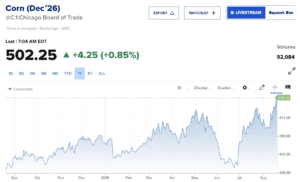
Corn Futures Above $5 for First Time in 18 Months
Bloomberg’s Ben Westcott reported that “corn futures topped the $5-a-bushel mark for the first time in 18 months as weaker-than-expected US crop tour results add to global supply concerns for the staple grain.”
“Reports from Western Iowa and Illinois released late Wednesday showed corn yields below those seen last year, according to data from the Pro Farmer Crop Tour. The two states are the country’s top producers,” Westcott reported. “The results come after yields in four other Midwestern states surveyed earlier in the week also came in below the tour’s prior three-year average.”
“Parts of the central US — where most of the crop is grown — were recently hit by severe storms, and the region also contended with sweltering temperatures earlier in the summer,” Westcott reported. “Most-active corn futures in Chicago rose by as much as 0.5% on Thursday to $5.005 a bushel, the highest since February 2025.”
“The subpar crop prospects in the world’s top corn exporter come after Europe was hit by a series of summer heat waves, with France forecasting its smallest corn harvest since 1980,” Westcott reported. “Plus, attacks in the Black Sea have slowed crop exports from Ukraine — another major supplier — to a trickle just before the corn harvest, potentially adding to the strain on global supply.”
“The gains for the grain helped push the Bloomberg Agriculture Spot Index to a three-year high this week. Still, the $5-a-bushel level for corn could trigger farmers to boost sales, helping to improve near-term availability and put downward pressure on prices ahead,” Westcott reported. “‘Overall, $5 will likely hold as significant resistance for now as we approach harvest,’ Naomi Blohm, an analyst at Total Farm Marketing, said in a Wednesday note.”
Pro Farmer Crop Tour Finds Lower Corn Yield in Illinois and western Iowa
ProFarmer’s Jim Wyckoff reported that “the Pro Farmer Crop Tour scouts on Wednesday traversed Illinois and Iowa. Their samples produced an Illinois corn yield estimate of 184.19 bushels per acre, down 7.7% from 199.57 bushels in 2025 and 7.5% below the three-year average of 199.15 bushels. USDA last week estimated an average yield of 212 bushels per acre for the state, a decline of 0.9% from 214 bushels last year.”
“Scouts found an average of 1,430.77 soybean pods in a 3’X3’ square (in Illinois), down 3.3% from 1,479.22 on last year’s Tour but up 2.9% from the three-year average of 1,389.65,” Wyckoff reported. “USDA projected the state’s average soybean yield at 67 bushels per acre, up 7.2% from 62.5 bushels last year.”
Scouts on #pftour26 found Illinois corn yield down nearly 8% on the year, the tour’s lowest Illinois yield since 2019. USDA projects the state’s yield to fall just 1% yr/yr.
Soybean pod counts were down more than 3%, though USDA sees soybean yield up 7% from last year. pic.twitter.com/zmqGG4bXoh
— Karen Braun (@kannbwx) August 20, 2026
“For Iowa, the Crop Tour found corn yields down in three Iowa districts (full Iowa results for corn and soybeans will be released Thursday),” Wyckoff reported. “In District 1, the average corn yield was 191.80 bushels per acre, down 3.1% from the 2025 Tour but up 3.3% from the three-year average. In District 4, the yield came in at 189.73 bushels per acre, down 8.5% from a year ago and 0.5% below the three-year average. And in District 7 the average yield was 190.59 bushels per acre, down 2.3% from last year and 0.05% above the three-year average.”
“On Iowa soybeans, District 1 saw 1,269.26 pods in a 3’X3′ square, down 0.78% from the 2025 Tour but up 8% above the three-year average,” Wyckoff reported. “District 4’s pod count came in at 1,273.77, down 7.4% from a year ago but up 1.9% from the three-year average. And District 7 saw 1,557.59 pods, down 0.3% from 2025 but 14% above the average.””
Weather, Harvest are Next Tests for Crop Prices
AgroLatam’s Emily Trask reported that “weather remains the major domestic variable. Forecasts showed measurable rainfall across much of the central United States, but most areas were expected to receive less than 0.25 inch, apart from portions of the Ohio River Valley.”
“The longer-range outlook pointed to wetter conditions across parts of the Northern Plains from August 26 through September 1, along with above-normal temperatures across the Midwest and Plains,” Trask reported. “Those conditions will keep attention firmly on final corn and soybean yields as combines begin providing actual field results.”
“The next test is whether stronger prices can survive the seasonal pressure of harvest. USDA export sales, actual field yields, Chinese soybean demand, ethanol consumption and Black Sea trade flows will all help determine whether Wednesday’s rally develops into a broader recovery or remains a short-term opportunity,” Trask reported. “With farm margins under pressure from input costs, every improvement in commodity prices matters. The challenge now is deciding how much production to price, how much to store and how much exposure to leave open if the market continues higher.”
