



Corn futures topped the $5-a-bushel mark for the first time in 18 months as weaker-than-expected US crop tour results add to global supply concerns for the staple grain.
Diesel Prices Soar Ahead of U.S. Harvest Season
Axios’ Ben Geman reported that “diesel prices are soaring just as the energy-thirsty peak of harvest season looms for many of the country’s largest crops. It’s a double whammy for farmers, with the Iran war also causing much higher fertilizer costs that hit months ago.”
“‘At the end of the day, unfortunately, the high prices have hit both in the spring during planting, and then they’re going to hit again in the fall during harvest,’ said Jed Bower, an Ohio corn and soybean farmer,” Geman reported. “Mid-August diesel prices are at their highest levels in the last decade, per AAA data. While 2022 had the all-time highest average recorded ($5.82 on June 19), prices are higher this year heading into harvest time for some key crops.”
“Bower, who holds the rotating presidency of the National Corn Growers Association, farms around 1,100 acres,” Geman reported. “He expects to pay an extra $20,000 to $25,000 in diesel costs this year compared to where prices were in January. And this comes as other costs have climbed, too, in the low margin business. ‘The way our input prices have been, there’s no way I can make a profit this year, and all this is going to do is bury me further,’ he said.”
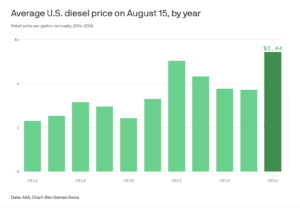
“The diesel market is tight and expensive for two main reasons: the throttled Strait of Hormuz, and the Ukrainian attacks on Russian refineries that have prompted Moscow to reduce exports,” Geman reported. “Fuel is a major input cost for farmers, who use diesel for combines, preparing fields, transporting crops to storage, irrigation and more. And farmers typically can’t pass those costs along to crop buyers.”
“Peak harvesting starts next month for corn and soybeans — the country’s two largest farm commodities — and several other crops, though specifics vary by location and product,” Geman reported. “‘Harvest is the single operation that uses the most fuel and runs from now through November for most of the country,’ said Drew Kientzy, a University of Missouri agricultural analyst.”
U.S. Diesel Supplies Remain Tight Ahead of Harvest
RFD-TV’s Tony St. James reported that “U.S. distillate inventories continue to tighten ahead of the fall harvest, keeping diesel costs a concern for farmers and rural businesses. Energy Information Administration data show distillate stocks fell again in mid-August and remain about 13 percent below the five-year average.”
“Crude oil supplies are less concerning. Commercial crude inventories increased during the week and remain near normal seasonal levels, while refineries operated at roughly 97 percent of capacity,” St. James reported. “That distinction matters because diesel is only one of several products refiners make from crude oil. Strong diesel crack spreads — the difference between crude costs and the value of refined diesel — signal particularly strong demand or tight supply for the finished fuel.”
“Crude availability may remain adequate, but tight distillate inventories leave less cushion if agricultural and freight demand strengthen through harvest,” St. James reported.
U.S. Diesel Crack Tops $100 for First Time
Reuters’ Shariq Khan reported that “the U.S. diesel crack, a key measure of refining profitability, hit an all-time high of $102.20 a barrel on Monday as global supply disruptions from the wars in Iran and Ukraine run into peak agricultural consumption season.”
“The most immediate hit from surging diesel cracks is to farmers who need the fuel to power tractors, harvesters and other equipment, during the ongoing harvest season in the Northern Hemisphere and the planting season in the Southern Hemisphere,” Khan reported. “Longer-term, it could hit most other sectors of the global economy as the fuel has wide-ranging uses from manufacturing to heavy transportation and power generation in parts of the world.”
“Global diesel stockpiles have been under immense pressure due to the ongoing wars, with both Russia and the Middle East among key suppliers of the fuel,” Khan reported. “Middle Eastern exports have been hit hard by disruptions to shipping through the Strait of Hormuz, while Russia has banned international sales through January due to Ukrainian attacks on its refineries.”
“U.S. refiners have ramped up diesel production to benefit from record high cracks, but stockpiles are still declining in the country due to strong export demand, said Shohruh Zukhritdinov, chief executive at oil trading firm NitrolOil,” Khan reported.
